✉ What the Letter Means
Plainly, first. This page is for educational purposes only. BuyItAt50 is not a telephone company, not a telecommunications engineer, not a lawyer and not a financial adviser, and it has no connection to any phone company. It explains published government rules and consumer guidance in plain words. For anything about your own line, your own service or your own devices, ask your phone company, your alarm or medical-alert company, or your state utility commission.
The letter usually arrives looking like every other letter from the phone company, which is the first problem with it. It says, in a good many more words than it needs, that the old landline is going away.

Here is what is actually happening. Phone companies across the country are retiring the old copper-wire networks and moving voice service onto fiber, wireless and internet lines in places where those are available. The Federal Communications Commission describes the copper as costly to keep up, harder and harder to repair, and often less reliable in extreme weather (FCC).
It is not happening everywhere on the same day. In Illinois, for example, AT&T’s letters told customers their traditional landline would be discontinued on or after March 15, 2027, and the company has announced plans to retire its copper landline network nationwide by 2029 (Citizens Utility Board). In parts of Massachusetts, Verizon has been moving landline customers from copper to fiber (Massachusetts DTC). Other companies are doing the same in other places.
So the first job is simply to read your own letter for your own date. The Illinois letters also said the old service would no longer be sold to new customers, that existing customers could not make changes to it, and that somebody who moved could not take it with them (CUB). Look for lines like that in yours.
And one small habit before anything else. If somebody telephones about the switch and wants payment or account details, hang up and ring the number printed on your own bill. The scams page explains why that one move settles nearly every call of that kind.
🔌 Why the Old Phone Never Went Dead
Most people never knew this, because they never needed to.
The old copper line carried its own electricity. The phone company sent it down the wire along with your voice, so when a storm took the power out, the telephone on the wall did not notice. The FCC puts it simply: traditional copper landline service typically works during a power outage, and the modern replacements usually need backup power to keep working (FCC).
A fiber phone line ends at a box in your house — the Massachusetts regulator calls it an Optical Network Terminal — and that box has to be plugged into an outlet (Massachusetts DTC). An internet phone runs through a modem, and the modem has to be plugged in too.
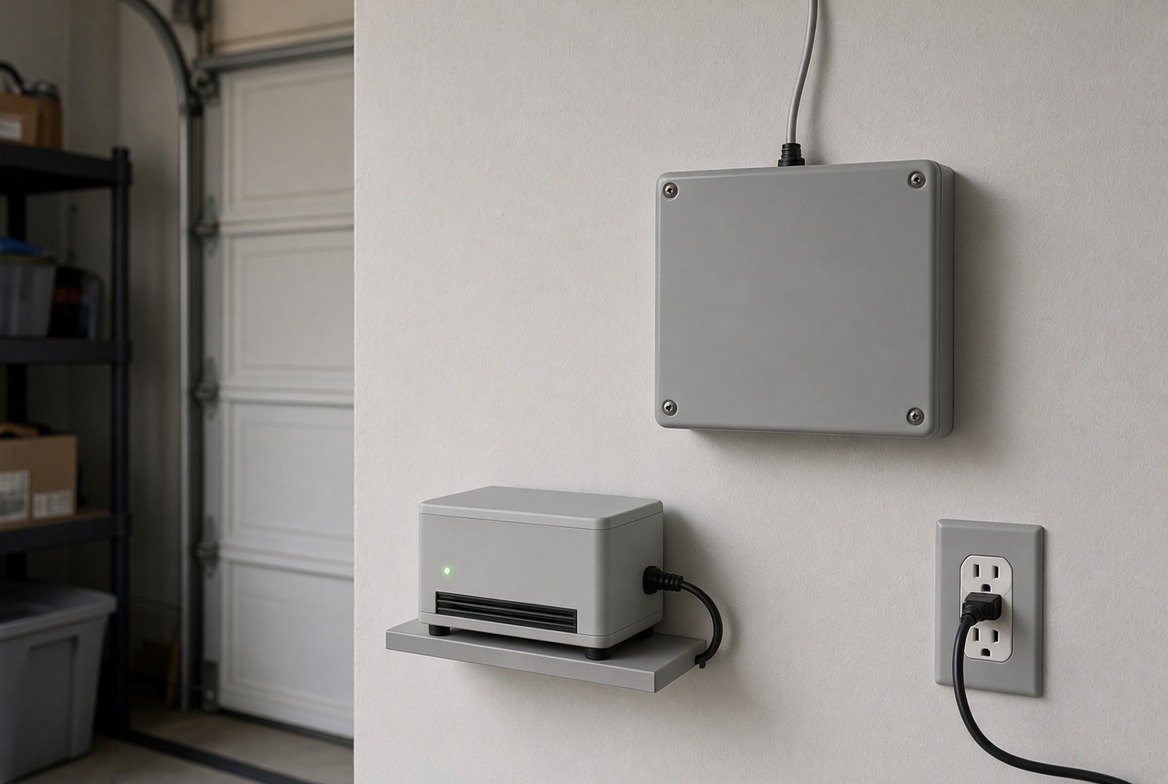
The old phone got its electricity from the phone company. The new one gets it from your wall socket.
That is the whole of the difference that matters on this site, because this site is mostly about the nights the wall socket stops working. The page on how the grid fails covers how often that happens and why.
🔋 The Battery, and What It Will Not Keep Alive
The government saw this coming, and it wrote a rule. Now I am going to give it to you flat, because it is the kind of thing where the exact words matter.
The federal backup power rule
47 CFR § 9.20Companies that provide home phone service over their own network, when that service is not powered by the line — including fixed wireless home phones sold as residential service — must offer customers, at the point of sale, the option to buy backup power (47 CFR 9.20). The rule is written for companies that run the network themselves. A phone service that simply rides over somebody else’s internet connection may not be covered, so ask.
They must offer at least one option with a minimum of 8 hours of standby power, and at least one option with a minimum of 24 hours of standby power.
The backup is offered at the customer’s option and expense. Nobody is required to buy it, and nobody gets it unless they ask (FCC rule, Federal Register).
Two words in there deserve a second look.
The first is option. It is offered, not installed. If you do not ask for it, you may not have it.
The second is standby. Standby hours are hours of the phone sitting ready and waiting. A long call on the fourth night of an outage is not standby, and it spends the battery faster.
The Massachusetts regulator adds the practical part: test the battery backup regularly, know how long it will last, and keep extra batteries on hand for a long outage (Massachusetts DTC).
The part that catches people. Describing one company’s wireless replacement service, Illinois’s Citizens Utility Board points out that its battery backup only helps a standard corded phone that does not need a power source of its own. It will not keep a cordless phone working, and it will not keep a Wi-Fi gateway or modem working — those need separate backup batteries (Citizens Utility Board). Ask whether the battery on your own service works the same way.
Which brings us back to an old friend. A plain corded telephone, the kind that plugs into the wall and has no power cord of its own, costs very little and needs nothing but the line. A cordless phone is a small appliance, and appliances stop when the power stops. The phone in the bottom drawer is a story built around exactly that.
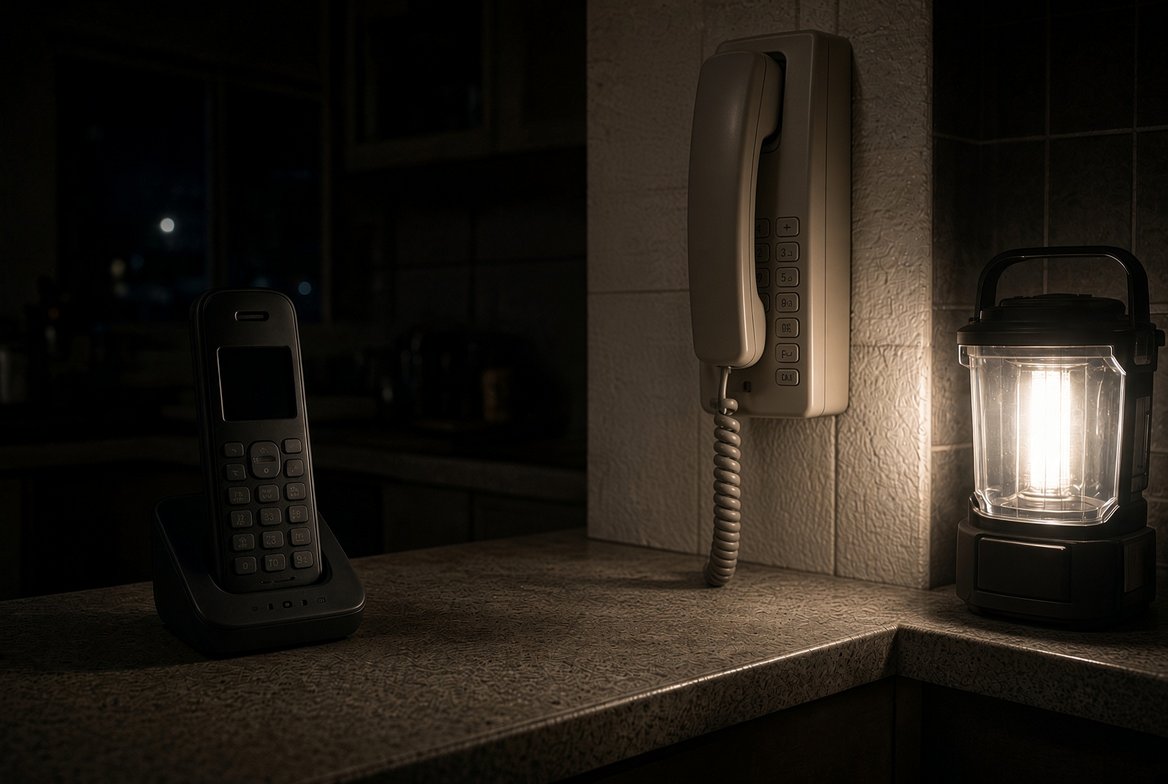
If your new service runs through a modem, the modem and the fiber box want a battery of their own on the bad night. The battery backup page covers what that looks like without anything bolted to the house.
🚨 911, Which Is the Part That Cannot Be Wrong
With the old copper line, the 911 center knew where the call came from because the line itself lived at your address. Internet phone service does not work that way, so the FCC set rules for it.
Interconnected internet phone providers must give 911 service to every customer and may not let anybody opt out of it. They must get your physical address before they switch the service on, give you an easy way to update it, and send your callback number and registered address along with any 911 call (FCC).
The FCC also tells customers what to do on their side, and it is short enough to write on a card:
Those four come straight from the FCC’s own guide (FCC). The Citizens Utility Board adds one more thing worth knowing: wireless and digital phone services use enhanced 911, and while the technology is improving, there are emergencies — such as when a caller cannot say where they are — where it may have trouble pinpointing the exact location (CUB).
That last point is why the medical information card and a clearly numbered house still matter. A dispatcher who cannot see you on a map needs the house to be findable.
🔔 The Alarm, the Pendant and the Heart Monitor
The landline has quietly been doing more jobs than making calls. Home alarms have long reported through it. Medical alert buttons have long dialed out through it. Some heart-monitoring equipment uses it too.
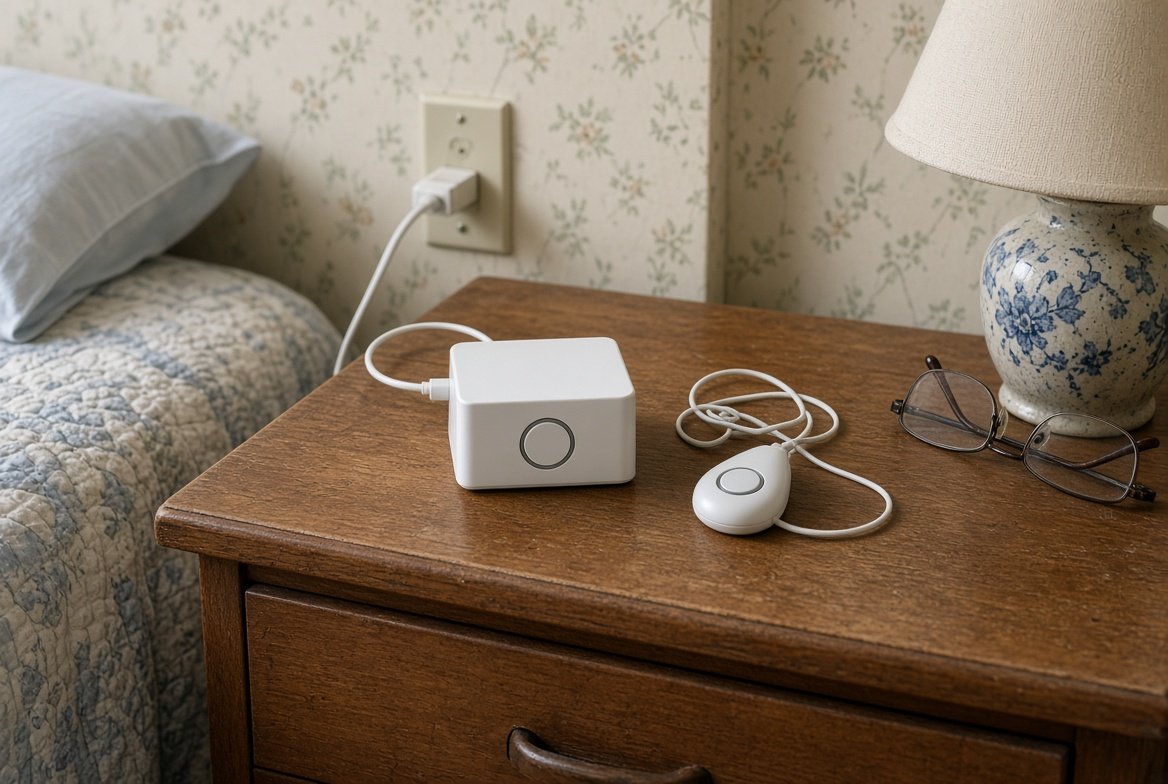
None of those care what your new phone plan costs. All of them care whether the line still behaves the way they were built to expect.
The Massachusetts regulator tells customers to inform the phone company, before switching, about any alarm or security system or medical equipment that relies on the existing phone line, to make sure it will keep working after the change (Massachusetts DTC). The Citizens Utility Board’s list of questions includes asking whether the new service works with fax machines, security systems, pacemakers or other medical-monitoring devices (CUB).
So make two phone calls, not one. Ask the phone company whether its replacement works with your devices. Then ring the alarm company and the medical alert company yourself and ask them the same question from their side. The phone company knows its line. The alarm company knows its box. Neither one knows the other half.
And then test it after the switch, while somebody is expecting the call. A medical alert that has never been pressed since the changeover is a medical alert nobody has checked. The home alarm page and the fall detection page both assume a working connection underneath them.
📞 The Choices You Will Actually Be Offered
When the copper goes, people are generally left with three kinds of home phone, and each has a weakness worth knowing before you choose it rather than after.
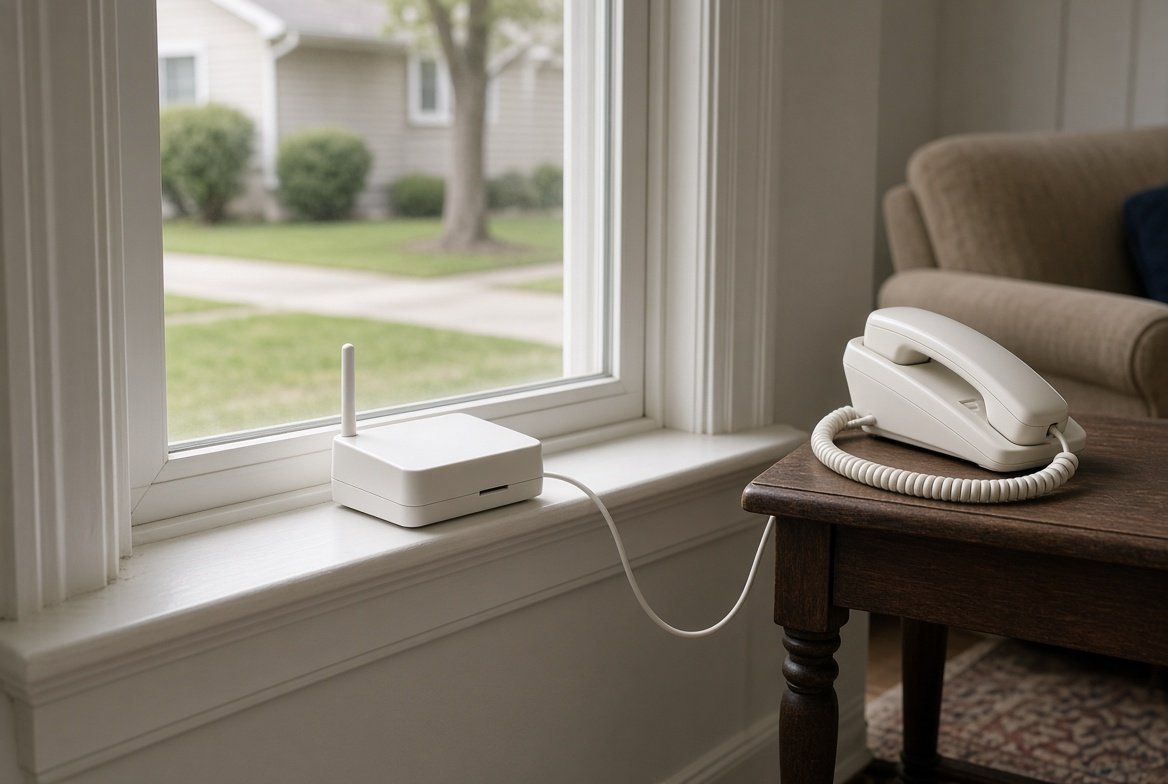
Internet phone service
VoIP / digital voiceCalls travel over the internet instead of the old phone line. It needs a broadband connection, and without a battery backup it does not work when the power is out or the internet is down. You may be able to keep your current phone and your number (CUB).
A wireless home phone
Fixed wirelessA box in the house connects to a cell network and lets you plug your ordinary phones into it. The Citizens Utility Board notes that one such service recommends placing the unit on the first or second floor near a window or outside wall for the best reception (CUB). Fixed wireless home phones sold as a landline replacement fall under the same federal backup-power rule described above (47 CFR 9.20).
Just the cell phone
MobileYou can move your home number to a cell phone (CUB). It goes where you go, which the wall phone never did. It also has to be charged, found, and carried from room to room — and on the night the power is out for three days, it has to be charged from something.
None of these is the wrong answer for everybody. The FCC notes that most American households have already moved to wireless only, or wireless plus an internet home phone (FCC). The right answer is the one whose weakness you have already planned for.
❓ The Questions to Ask Before You Say Yes
This is the part to print. It is plain on purpose. Take it to the telephone, ask every question, and write the answers down with the date and the name of whoever gave them.
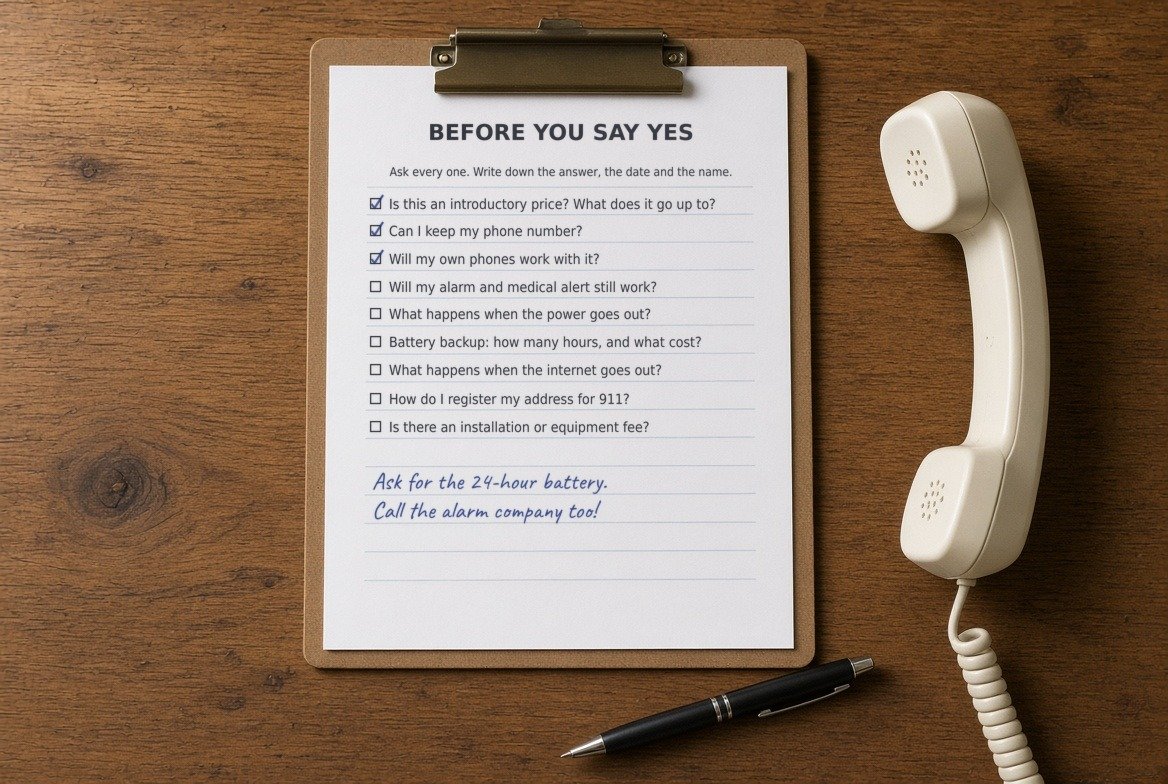
Before you choose a replacement
Ask every one- Is this price an introductory rate, and what does it go up to, and when?
- Can I keep my current phone number?
- Can I keep using my current phone? (Rotary and pulse-dial phones may not work.)
- Does it work with my alarm, my medical alert, my heart monitor, my fax?
- What happens when the power goes out? Is there a battery backup, how many hours of standby does it give, what does it cost, and what does it keep running?
- What happens when the internet goes out?
- Do I need to register my address for 911, and how do I update it?
- Is there an installation or equipment fee?
Drawn from the Citizens Utility Board’s checklist (CUB), the FCC’s 911 guidance (FCC) and the Massachusetts regulator’s advice (Massachusetts DTC).
One more question belongs on the list, and it is the one almost nobody thinks to ask. In Massachusetts, the regulator warns that a regulated fiber landline replacement and a bundled digital voice product can look alike but are not the same, and that the state’s consumer protections apply to one and not the other (Massachusetts DTC). The rules differ from state to state, so ask your own company plainly: which of your products keeps the protections I have now?
Then read the first bill after the switch, line by line. The Massachusetts regulator gives exactly that advice (Massachusetts DTC), and the phone bill page explains why the first bill is the one worth reading.
🏛 If Nothing on Offer Will Work Where You Live
For some people, especially out in the country, the honest answer is that the cell signal is poor, the internet is poor, and the old copper was the only thing that ever worked reliably.
That matters, because the FCC generally lets companies discontinue the old service unless it is shown that no adequate replacement is available in a given area (AARP). Before a phone company retires copper, it has to tell customers what is going to happen and how it will affect their service (FCC).
What you can do about it depends on your state. In Illinois, customers who believed they would be left without reliable phone service, including access to 911, could ask the state commission to investigate (CUB). So if you are in that position, contact your state public utility commission, tell them plainly what does not work at your house, and do it before the date in your letter.
A fair word about where some of this comes from. The Citizens Utility Board is a consumer advocate that opposed the end of landline service in Illinois, and it says so openly. Its practical checklist is sound whichever side of that argument you are on, but its view of the change itself is an advocate’s view, and the phone companies and the FCC see it differently.
⚡ Why This One Is on the Fifty List
Because the telephone on the wall is the last thing in the house that nobody ever had to learn.
It did not need charging, updating or a password. Your grandmother used it and so did your grandson. On the worst night of the year it was the one thing that did not need anything from you at all.
What replaces it will need a little. A battery that somebody tested. A corded phone in a drawer. An address registered for 911. Two phone calls about the alarm and the pendant. None of it is hard, and all of it is easy to do on an ordinary Tuesday and very hard to do in the dark.
So do it when the letter comes, not when the storm does. And if you are helping a parent, do it with them and write it down for them — AARP’s Senior Planet runs free online classes on what the copper retirement means (AARP), and a patient hour with a grown child is worth more than either.
The old phone never asked anything of you. The new one asks for about an afternoon. That is a fair trade, as long as you give it the afternoon before you need it.
❓ Questions People Actually Ask
Will my new home phone work when the power goes out?
Only if it has backup power. The old copper landline carried its own power, but fiber and internet phone service depend on equipment plugged into your wall. Providers must offer you the option to buy backup power with at least 8 hours, and an option with at least 24 hours, of standby power, but you usually have to ask for it and pay for it.
Will my cordless phone work on the battery backup?
Usually not. A battery backup on the phone company’s equipment can keep a standard corded phone working, but a cordless phone needs power of its own, and a separate modem or Wi-Fi gateway needs its own backup battery too. A plain corded phone is the one to keep for outages.
Will 911 still work after my landline is switched?
Yes, as long as the service has power and a connection, and your address is registered. Internet phone providers must provide 911 to every customer and send your registered address with the call, so give them your accurate address and update it if it changes. It may not work during a power or internet outage without backup.
Will my medical alert or home alarm keep working?
Do not assume it will. Tell your phone company about any alarm or medical device that uses your phone line before the switch, ask the alarm or medical alert company whether their equipment works with the new service, and test it afterwards.
Do I have to switch when I get the letter?
If your phone company is retiring the old service in your area, the old line will stop working on or after the date in the letter. You can choose the replacement service, a different company, or a cell phone. If you believe nothing available will work reliably at your address, contact your state public utility commission before that date.
Can I keep my phone number?
Often, yes. Consumer guidance for customers affected by landline retirement says you may be able to keep your number with a digital replacement service or move it to a cell phone, but ask the company to confirm before you agree to anything.
📚 Where This Comes From
Every statement of fact on this page traces to a federal agency, a state regulator or an established non-profit, and each is linked where it appears. Nothing here comes from a company selling phone service or equipment. Rules, dates and products change — check with your phone company and your state commission before you act.
- Why copper is being retired, and what the FCC expects of companies — Federal Communications Commission, Tech Transitions.
- Copper working in outages, and notice before retirement — Federal Communications Commission.
- The backup power requirement — 47 CFR § 9.20 and the FCC rule in the Federal Register.
- 911 on internet phone service — FCC consumer guide, VoIP and 911 Service.
- Fiber equipment, battery testing, alarms and medical devices, regulated service — Massachusetts Department of Telecommunications and Cable.
- The Illinois letters, replacement options and the question checklist — Citizens Utility Board, a consumer advocate.
- How the FCC decides, and free classes — AARP.