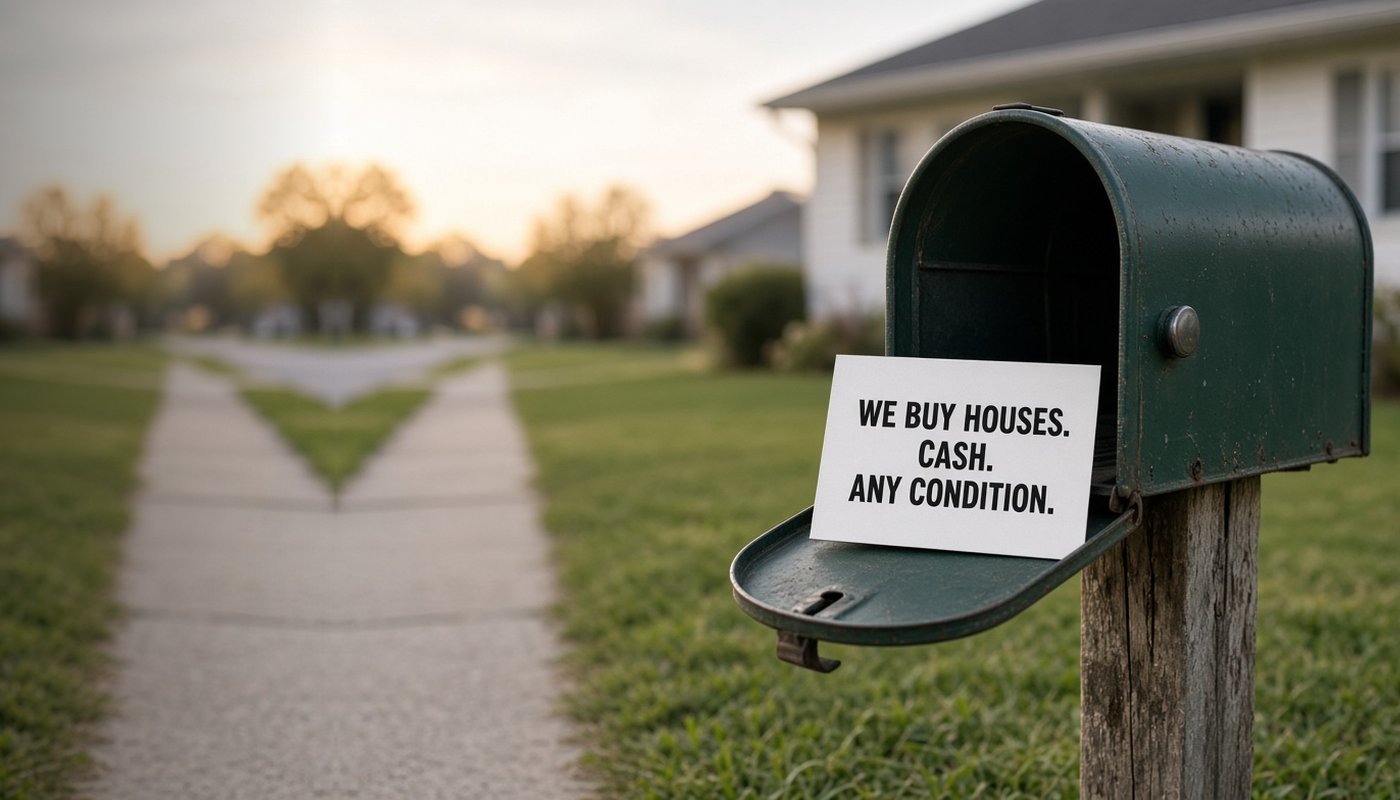
📬 The Card in the Mailbox
Plainly, first. This page is for educational purposes only. BuyItAt50 is not a real estate agent or broker, an appraiser, a lawyer, a housing counselor, a tax adviser or a financial adviser, and it has no connection to any company that buys, sells, lists, wholesales or appraises houses. It names no company, and nothing on it is a statement about any company or any person who sends these offers. Many of them operate within the law. The figures quoted here come from AARP, federal agencies and state officials, and the laws described differ from state to state and change over time. Whether a particular contract is fair, binding or cancelable is a question for a real estate attorney in your own state.
It comes as a postcard, an email, a robocall or a text. Or it is a sign by the road that says We Buy Houses or Cash for Homes (AARP).
Nothing on it has to be a lie. There may really be cash, and the house may really be bought as it stands.
What the card leaves out is who is doing the buying, and at what price. The practice has a name, residential real estate wholesaling, and AARP does not mince words about it: these pitches are probably not in your best financial interest (AARP).
This page is not going to tell you never to sell a house for cash. People do it for sound reasons. AARP’s own housing staff say plainly that some people will still decide the convenience is worth more to them than the price, and that what matters is having all the information when they do (AARP).
So this page asks for one thing only. Before you pick up the phone, know what the house would bring from anybody else.
🔁 Who Is Actually Buying
Most commonly there are three parties to the deal, and you meet only one of them.
The wholesaler agrees to buy your house at a price below market value. Then, rather than buy it, he sells that agreement to an investor for more than the price written in it (AARP). The difference is his. He may never own your house for a single day.
All three as reported by AARP (AARP). They describe the practice, not any particular offer or company.
The 60 percent figure comes from Keith Clayton, a special deputy attorney general in North Carolina, and he has a blunter name for the business. He calls it equity stripping, and he says the biggest risk is that you lose the equity you built up in your home (AARP).
Equity is the part of the house that is yours: what it would sell for, less whatever is still owed on it. On a house paid off years ago, that is very nearly all of it.
The trade is lightly watched. AARP describes it as largely unregulated, notes that in many states a wholesaler needs no license the way a real estate agent does, and says the complaint heard most often about homebuying companies on the Better Business Bureau’s website is calls, emails and texts that keep coming after the homeowner has asked them to stop (AARP).
The contract may not even stay with the person who signed it. A Nebraska Real Estate Commission official told AARP that a house put under contract can be passed to 14 other wholesaling companies within an hour, and that if it does not sell quickly the closing may never happen at all (AARP).
An agent you hire is usually paid on the price your house brings. The postcard is sent by somebody who is paid on the gap between your price and the next man’s. There is nothing unlawful in that by itself. It is simply worth knowing which side of the table each of them is sitting on.
🎯 Why It Came to Your House
It is not a coincidence, and it is not personal. It is arithmetic done on public records.
AARP says these companies can pick out ZIP codes with a high share of older homeowners who likely have a good deal of equity, and that they go through public records looking for foreclosure filings, divorces and recent deaths (AARP). North Carolina’s Clayton says they find homeowners in difficult situations and pressure them to sign quickly and close quickly (AARP).
A search can put you on the list too. Clayton warns that the name and address typed into a website while looking for a short-term or home equity loan can be bought by scammers and by companies that buy houses, and that they hunt for people in desperate financial situations (AARP).
The worst week to get one is the week it is most likely to come. The Nebraska commission’s deputy director for enforcement told AARP that the time right after a parent dies is a bad time to hear from somebody offering money for the house, and that the offer can be appealing to people in distress (AARP). If you are the one left behind, nothing about the house has to be decided this month. The page on the month nobody prepares for covers what does.
📄 What Can Be Hiding in the Paper
The low offer is not usually where the money goes. It goes in the paper that follows.
What state officials have found in these contracts
Read before signing- No end date. A guide from the Nebraska Real Estate Commission warns that some of these contracts can last for years, making it impossible for the homeowner to sell to anybody else (AARP).
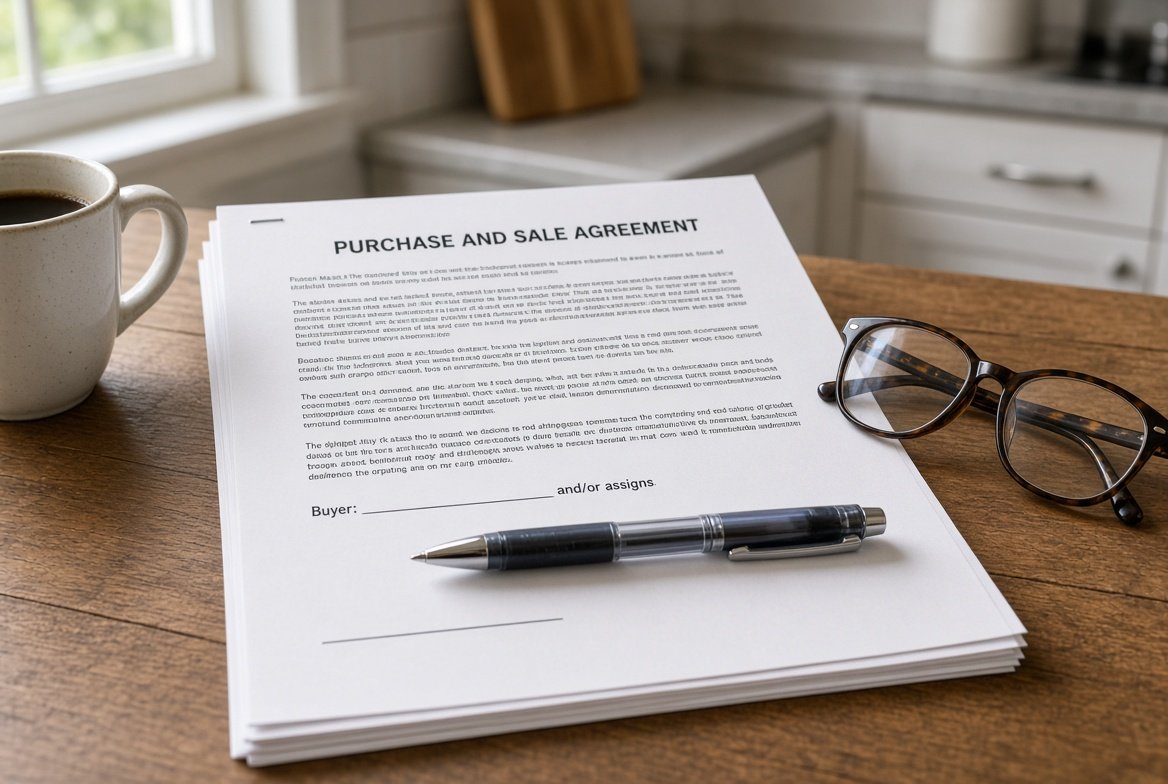
- A different paper from the one described. In North Carolina, Clayton says, homeowners were told they were signing a receipt for a cash advance when they were actually signing a purchase-and-sale agreement, or even a deed (AARP).
- A way out for one side only. The Nebraska commission’s director says the contracts often let the wholesaler cancel for any reason, and walk away if there is no profit in it (AARP).
- “As is” that stops being as is. The Pennsylvania attorney general’s office warns that buyers sometimes take back that promise and demand repairs before they will accept the deed, leaving the seller paying for the repairs after all (AARP).
- The mortgage left behind. For homeowners trying to avoid foreclosure, the same office warns that a buyer may take the deed without paying off the mortgage, leaving the seller still responsible for the payments and still facing foreclosure (AARP).
- Signed on a telephone. A real estate agent told AARP of homeowners put under contract on the small screen of a smartphone, without being told the company would sell the contract to somebody else (AARP).
Once it is signed, getting out is the hard part. Clayton says unwinding one of these purchase-and-sale agreements can be very difficult and very expensive, and that the people running the bad ones do not hesitate to enforce the contract aggressively (AARP). The time to have somebody read it is before the pen touches it.
And there is a rule people assume will save them that does not apply here.
The Federal Trade Commission’s Cooling-Off Rule, the one that gives you three days to cancel many sales made at your own front door, expressly excludes transactions for the sale or rental of real property (eCFR). A house is real property. Whatever right you have to back out of a contract to sell your house comes from the contract itself or from your state’s law, not from that federal rule. The contractor page explains what the rule does cover.
The advice AARP passes on from the Nebraska commission’s director is to talk to an attorney before entering a transaction like this. If that is out of reach, have a trusted friend or family member read the contract before you sign, because once it is signed it is hard to escape (AARP).
🏡 Find Out What the House Is Worth
Here is the whole defense in one sentence. Clayton says these operators turn a handsome profit by preying on people in desperate situations who do not know the true value of their homes (AARP).
So know it.
A senior attorney at the National Consumer Law Center told AARP that most homeowners have been misled into believing their property is worth a lot less than it actually is, and that the most important protection of all is an appraisal before the contract is final (AARP).

There are four ways to get a number. They run from free to paid, and not one of them requires answering the postcard.
Four ways to a number of your own
Before anybody else’s1. What the houses around you sold for. The Nebraska commission’s deputy director told AARP that the first thing to do, if you are ready to sell, is figure out what the house is worth, and that looking up what a neighbor’s house sold for is a place to start (AARP).
2. A licensed real estate agent’s opinion. Better still, she said, ask a real estate agent to work out your home’s market value (AARP). Asking what the house would sell for does not commit you to selling it, and your state’s real estate commission can confirm that the agent is licensed.
3. The county assessor’s website, with a warning attached. AARP lists it as a place to research prices (AARP). But the value on your tax bill is a number for taxes, and it may be nowhere near a price. In California, for example, a home is generally assessed at its purchase price, and after that its assessed value can rise by only two percent a year, or the rate of inflation if that is lower, until it sells (Sonoma County Assessor). A house bought thirty years ago can carry a tax value well below what it would bring today. Relief programs that freeze the assessed value do the same thing, as the property tax page explains. If anybody points at your tax bill to tell you what the house is worth, you have learned something about them, not about the house.
4. An independent appraisal. This is the one the consumer lawyer called the most important protection. The federal Appraisal Subcommittee keeps a National Registry of state licensed and certified appraisers, built from information sent by the state that issued each credential, and trainees do not appear on it (ASC). You can look an appraiser up there by name through the National Registries page. An appraiser you hire and pay yourself is not being paid by anybody who wants to buy your house.
“Scammers count on people’s ignorance,” is how AARP summed up the Nebraska commission’s advice (AARP). An hour spent finding the number is the cheapest thing on this page.
If money trouble is what made the postcard look good, there is free help for that before anything is sold. HUD-approved housing counseling agencies provide foreclosure prevention counseling free of charge, and can help you talk to your mortgage servicer about the options it has offered (CFPB). The Consumer Financial Protection Bureau’s Find a Counselor tool lists the ones near you.
🚫 What to Do With the Postcard and the Calls
Do not answer it, not even to tell them to stop. Clayton warns that responding tells them the number is good, that there is a live person on the other end, and that you are still a potential lead (AARP).
Instead, a few quiet things that cost nothing.
- Put your phone numbers on the National Do Not Call Registry at DoNotCall.gov (AARP).
- Forward unwanted texts to 7726, which spells SPAM on the keypad. The FTC says this helps your wireless provider spot and block similar messages (FTC).
- Ask whether your city goes further. Philadelphia, for one, created a do-not-solicit list, and wholesalers there are prohibited from contacting homeowners who have said they do not want offers (Community Legal Services). Ask your own city or county whether it has anything like it.
- If you think you have been cheated, report it to your state attorney general’s office or your state real estate commission, and if it happened online, to the FBI’s Internet Crime Complaint Center at IC3.gov (AARP). The after-a-scam page covers the first forty-eight hours.
⚖️ The Rules Are Changing, One State at a Time
This part moves quickly and is different in every state, so read it as examples, never as a statement of what your rights are.
The senior attorney at the National Consumer Law Center told AARP that some states already require disclosures, licensing or a grace period, but most have nothing aimed specifically at this problem, which is how it has been able to spread (AARP).
What AARP is asking for. In 2026 AARP published model legislation that would require wholesalers to be licensed and insured, to pay for an independent appraisal of the home, and to let the homeowner cancel the contract right up until the deed is transferred, along with protection from incessant calls and messages such as a do-not-call list (AARP). The full legislative guide and model act is published by AARP.
Rhode Island. A bill that became law in June 2026, according to AARP, requires wholesalers to hold a valid real estate license, to make clear that they could sell the contract before closing, and to allow three days to cancel a signed contract without penalty (AARP).
Ohio. A bill passed in December 2025 allows homeowners to cancel the agreement any time before the close of escrow if the wholesaler did not provide the disclosures the law requires (AARP).
South Carolina. The state’s revised Real Estate Practice Act, signed in May 2024, includes a prohibition on wholesaling as that law defines it (S.C. Real Estate Commission).
West Virginia. Bills to abolish wholesaling were introduced in 2025 and 2026, and neither came to a vote (AARP).
To find out what applies where you live, ask your state’s real estate commission or the consumer protection division of your attorney general’s office, and have a real estate attorney in your state read any contract before you sign it.
⚡ Why This Belongs on the Fifty List
At fifty, the postcard goes in the trash with the rest of the mail, and it should.
That is exactly why fifty is the time to do the two things that make every future postcard harmless.
The first is to know, roughly, what the house is worth, and to look again every few years. Not in order to sell it. In order to know it.
The second is a family rule, said out loud: nothing about this house gets signed in a hurry. Not by you at eighty on a bad week. Not by your wife in the month after a funeral. Not by a son on the screen of his telephone. The deed, the name of the county assessor’s office, and the name of somebody who can read a contract all belong in the folder your family will need.
None of that is suspicion of anybody. It is simply the one piece of homework the postcard is counting on you not to have done.
Somebody has already worked out what your house is worth. The postcard only works if that somebody is not you.
❓ Questions People Actually Ask
Are “We Buy Houses” offers a scam?
Not always, and many are legal. But AARP reports that homeowners who sell through a real estate wholesaler usually get only about 60 percent of the home’s fair market value, according to a North Carolina special deputy attorney general. Find out what the house is worth before you answer.
What is real estate wholesaling?
A wholesaler signs a contract to buy your house below market value, then sells that contract to an investor for more. The wholesaler keeps the difference and may never own the house at all.
How do I find out what my house is really worth?
Look up what similar nearby houses sold for, ask a licensed real estate agent, or pay for an independent appraisal. An appraisal should be done by a state licensed or certified appraiser. The assessed value on your tax bill is a figure for taxes, not a sale price.
Can I cancel a contract to sell my house to a cash buyer?
It depends on the contract and on your state. The FTC’s three-day Cooling-Off Rule does not help, because it excludes the sale of real property. Some states, including Rhode Island and Ohio, have added cancellation rights for certain wholesale contracts. Have an attorney read the contract before you sign.
How do I stop the calls, texts and postcards?
Do not reply, even to ask them to stop. Add your numbers to the National Do Not Call Registry, forward spam texts to 7726, and ask whether your city keeps a do-not-solicit list, as Philadelphia does.
📚 Where This Comes From
Every figure on this page is linked where it appears, and every source is listed again here. This page names no company that buys, sells, lists, wholesales or appraises houses.
- How wholesaling works, the 60 percent figure, targeting, contract problems, knowing your home’s value, stopping contact and reporting — AARP, What to Know About Those ‘We’ll Buy Your Home’ Ads and Mailers, quoting the North Carolina Attorney General’s office, the Nebraska Real Estate Commission and the Pennsylvania Attorney General’s office.
- The model act, state laws in Rhode Island, Ohio and West Virginia, appraisals and the smartphone contract — AARP, AARP Tackles Predatory ‘We Buy Homes for Cash’ Offers, and AARP’s Legislative Guide to Residential Real Estate Wholesaling: Report and Model Act.
- South Carolina’s wholesaling prohibition — South Carolina Real Estate Commission, Advisory Opinion on Exceptions to Wholesaling.
- The Cooling-Off Rule’s real property exclusion — 16 CFR 429.0, Electronic Code of Federal Regulations.
- How assessed value can differ from market value — County of Sonoma Assessor, How Property Values Are Assessed.
- Checking an appraiser’s credential — Appraisal Subcommittee, Frequently Asked Questions and National Registries.
- Free foreclosure prevention counseling — Consumer Financial Protection Bureau and its Find a Counselor tool.
- Spam texts — Federal Trade Commission, How to Recognize and Report Spam Text Messages.
- Philadelphia’s do-not-solicit list — Community Legal Services of Philadelphia.