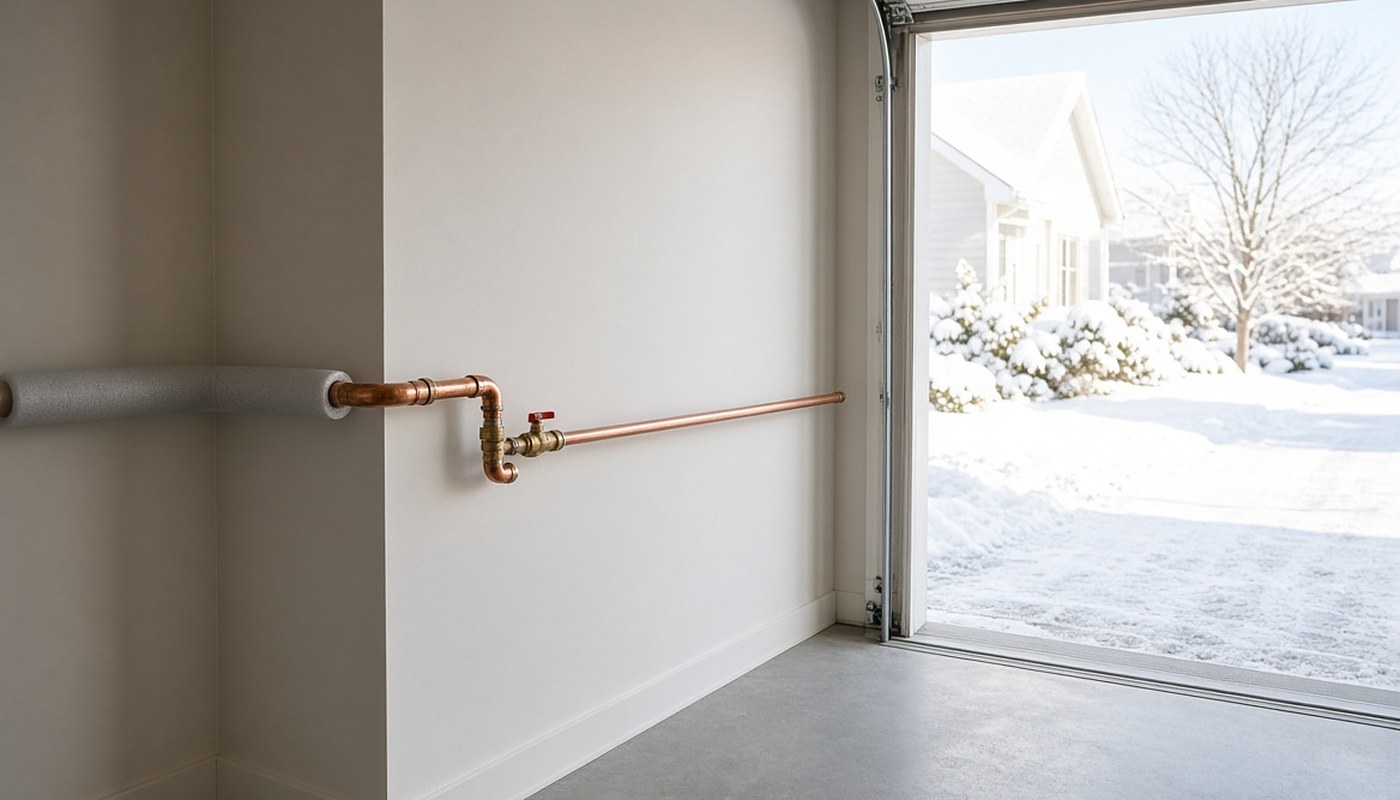
🌡️ Twenty Degrees, Not Thirty-Two
Plainly, first. This page is for educational purposes only. BuyItAt50 is not a plumbing company, not a plumber, not an engineer and not a building inspector, and it has no connection to any company that sells any of the things described here. It explains published research and consumer guidance in plain words. For your own house, your own pipes and your own weather, ask a licensed plumber in your county and your own water utility.
Water freezes at thirty-two degrees. Everybody knows that, and it is the reason a good many people spend the first cold night of the year worrying about nothing, and the fourth one asleep while the damage is being done.
Pipes do not freeze at thirty-two. The number that matters is about twenty degrees outside.
That figure comes from field tests run by the Building Research Council at the University of Illinois, which put real water systems through real winter weather and found that uninsulated pipes in an unheated attic started to freeze when the outdoor temperature fell to twenty degrees or below. It is published now as the temperature alert threshold, and it has been checked against the people who get the call: a survey of seventy-one plumbers working in southern states put the start of burst-pipe trouble at about the same place, when the thermometer dropped into the teens.
Two things put that dozen degrees between the freezing point and the trouble point, and both are worth knowing because they are also the reasons the rule sometimes breaks.
The first is that an unheated part of a house is nearly always a few degrees warmer than the yard. An attic at thirty-two outside may be sitting at thirty-seven or thirty-eight. The second is stranger and older than any building: still water will supercool several degrees below freezing before it makes up its mind to become ice. Both of those are buying you time, and neither of them is a promise.
So the threshold is a place to start watching, not a wall. A pipe with a draught blowing on it will freeze well above twenty. A gap around a dryer vent, a missing scrap of insulation, a hole where a cable comes through a rim joist — a tiny opening and a windy night will do what the thermometer says should not be possible yet. The pipes that fail are almost never the ones in the middle of the house. They are the ones nobody thought of.
💥 The Pipe Does Not Burst Where the Ice Is
This is the one fact on this page worth carrying around, because almost nobody has it and it changes what you do.
And if you are closing rooms off for the winter to keep the bill down, this is the fact that decides how far you can take it — see when you cannot heat the whole house.
Water expands about nine percent when it turns to ice, and that expansion is powerful enough that no ordinary pipe — copper, steel, plastic, it makes no difference — can contain it. That much is common knowledge. What is not common knowledge is the sequence.
The ice does not swell up and split the pipe outwards like a can of soda in a freezer. What happens is that ice forms a plug somewhere cold, and then keeps growing. The water on the far side of that plug has nowhere to go, because at the other end of it is a faucet that is shut. It is trapped between a plug that is getting bigger and a valve that is not moving, and the pressure climbs until something lets go.
The split usually turns up on a length of pipe with little or no ice in it. The ice was the cause. It was not the location.
Which explains the piece of advice everybody has heard and almost nobody has heard correctly. You are not leaving the tap dripping to keep the water moving. Moving water freezes too. You are leaving it open so the pressure has somewhere to go. If the pressure cannot build, the pipe does not split, and a pipe full of ice that never split is a nuisance for a morning rather than a catastrophe.
The drip can be very slight indeed. At normal house pressure the slowest drip you can set gives all the relief that is needed. And it only wants doing at the taps fed by pipes running through cold spaces — not every faucet in the house, which just runs the well pump or the water bill up for nothing.
And if you are about to ask what your pipes are made of
Everybody with plastic pipe has heard that it does not burst, and everybody with copper has heard that it does. The truth is more interesting than either, and the argument about it is being conducted almost entirely by people who sell pipe.
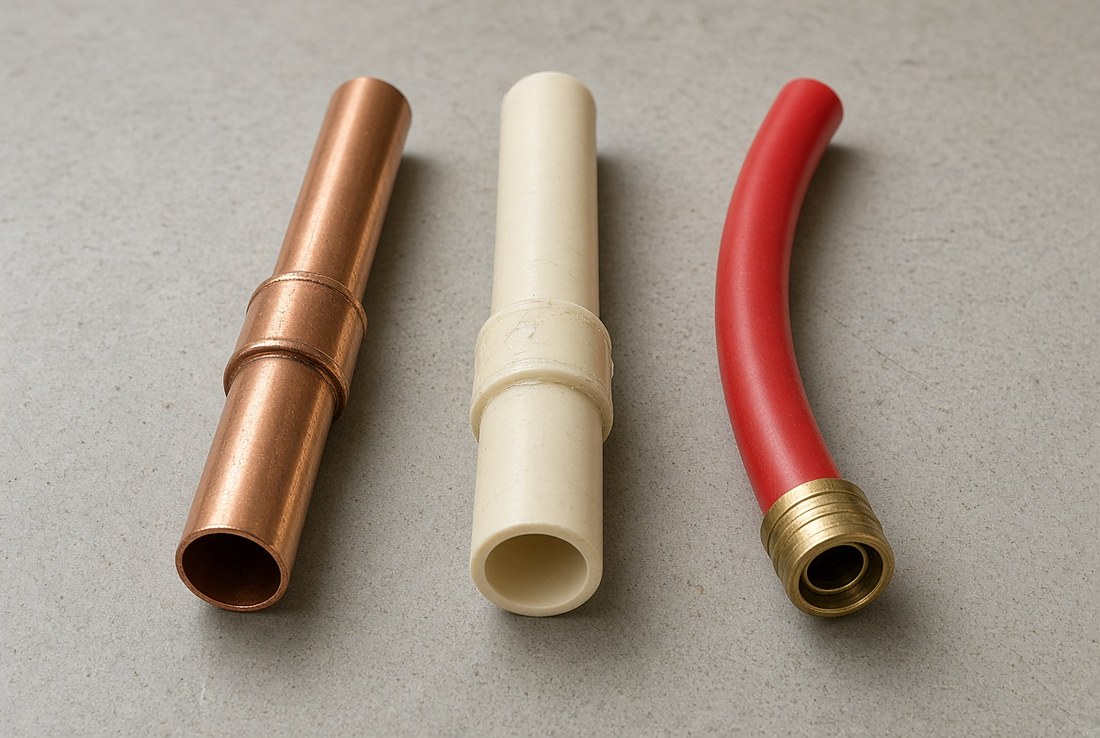
Here is what is not in dispute. Copper is rigid and conducts heat extraordinarily well — the Plastics Pipe Institute puts copper at about 196 on the thermal conductivity scale against 2.86 for PEX, which is not a small gap but a seventy-fold one. Water in a copper line therefore gets cold faster, and when the ice pushes, the pipe does not give. It splits. CPVC is a plastic but a stiff one, and it gets brittle in real cold, so rather than bulging it tends to crack. Galvanized steel, in the older houses that still have it, behaves like copper only heavier. And PEX is flexible enough to swell a little and come back, which is genuinely an advantage and genuinely why it has a reputation.
Now the argument. The Plastics Pipe Institute — the trade association for the plastics side — publishes a technical report specifically on the freeze-break resistance of PEX, and it is favourable, as you would expect. A CPVC manufacturer publishes a rebuttal titled, more or less, that freeze-proof pipe is a myth, and makes two points worth hearing: PEX did burst in the February 2021 Texas freeze, in quantity, and field-aged PEX has never been tested frozen — the tests are run on new pipe, while pipe that has sat in chlorinated water for years develops a thin brittle layer on the inside that new pipe does not have.
Both of those companies are selling something, and we are not. So here is the part they agree on, which is the part that matters to you: every one of these materials bursts under enough ice pressure, and on all of them the fitting usually goes before the pipe does. The elbows, the couplings and the valves are where a freeze finds its way out, whatever the straight lengths are made of.
Which means the answer to what your pipes are made of is: it changes your odds and it changes nothing else. A PEX house that freezes hard enough, often enough, will eventually give you a wet ceiling the same as a copper one. The hose still comes off in October either way.
The reason this is worth the ten seconds it takes to understand: it tells you which taps to open, and it tells you why a pipe that has already frozen must have its faucet left open while it thaws, rather than shut to keep the mess down. Shutting it is exactly the wrong instinct and exactly the one most people have.
🏠 Where It Happens in Your House
This site is read in every state, and the honest answer to where depends entirely on how your house was put together. So here is the whole spread rather than one region's version of it.
The American Red Cross lists three families of vulnerable pipe, and between them they cover nearly every house in the country.
The three places pipes freeze
Now put that against the house you actually live in, because the answer really does change.
If you have a basement — which is the ordinary arrangement across the Northeast, the Midwest and much of the Mid-Atlantic — the main comes in through the foundation wall, and the pipes run along the joists overhead where you can see them. The good news is that a basement is warmer than the outdoors and everything is reachable. The bad news is the rim joist: the band of framing right at the top of the foundation, riddled with holes where wires and pipes and dryer vents pass through, and often insulated by somebody in a hurry. That is where the cold gets in, and the pipe nearest to it is the one that goes.
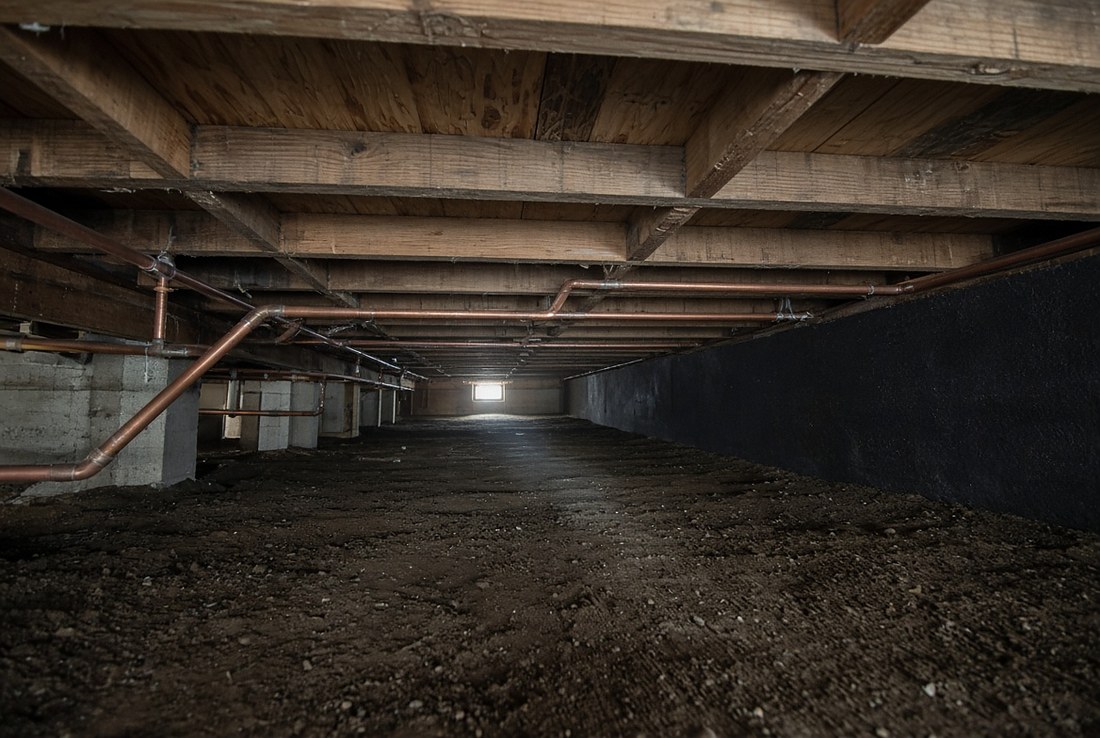
If you have a crawlspace — common through the South, the mid-South and a good deal of the rural country everywhere — the pipes are underneath you in a cold, vented, awkward space, and the foundation vents that keep it dry in August are the same vents that let January in. Closing or blocking those vents for the winter is standard practice in a lot of places and forbidden in others; it is a question for your own building department, not for a website.
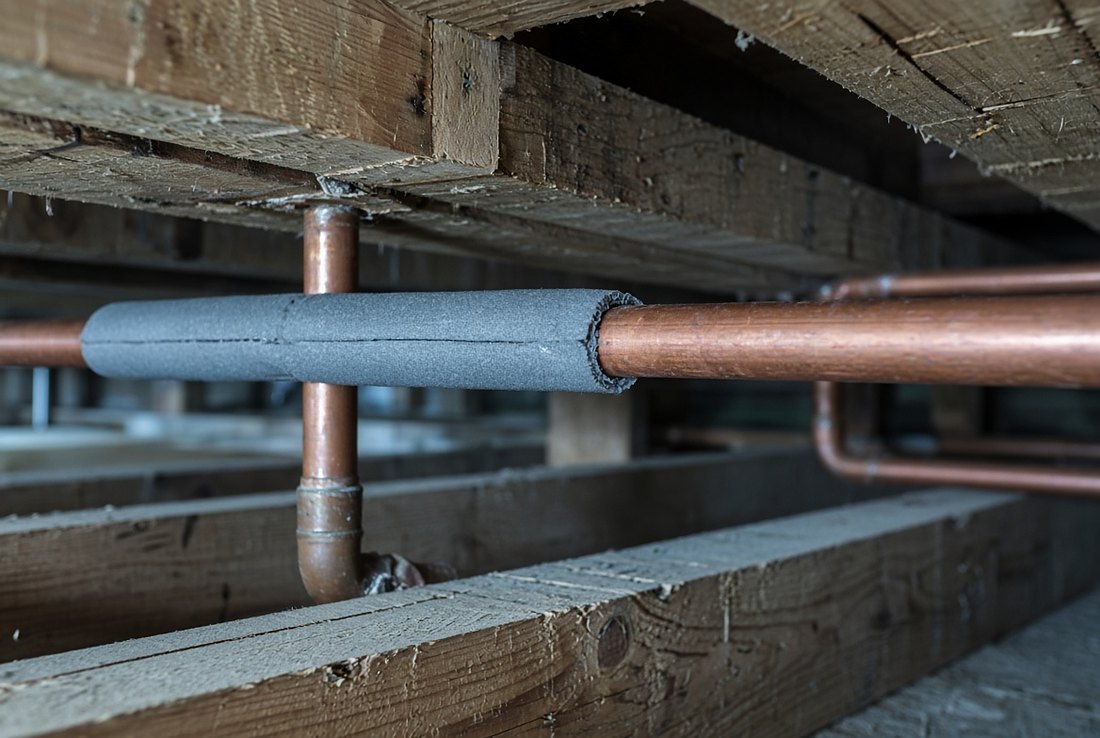
If you are on a slab — the usual thing across Florida, the Gulf, Texas and much of the Southwest — the supply lines are in the walls and the attic rather than under the floor, and the attic is the one that catches people. It is also the case that these houses are built in places where a hard freeze is an event rather than a season, which is precisely why they are built with the least protection and precisely why the twenty-degree research was aimed at them in the first place.
And if you are on a well, the failure is a different one altogether. A frozen well line does not usually give you a flood. It gives you no water at all — and the parts that freeze first are not the ones in the house. They are the wellhead, the run between the wellhead and the building, and above all the pressure tank and pressure switch, which in a great many places live in an unheated pump house, an outbuilding or a pit. A pressure switch frozen in one position can leave the pump running against a blockage; frozen in the other it simply leaves you dry. Purdue Extension's own winter power-failure guidance treats a well as a separate job from the start: shut the water at the main or shut the well pump off, and drain the pressure tank. There is more on that, including what the pump itself does and does not tolerate, on the well and sump pump page.
If you are in a mobile or manufactured home, the water lines run in the belly of the house under the floor, and the skirting is the only thing standing between them and the wind. That is its own situation, and it is the one place where heat tape is nearly universal — which is a section of its own further down this page, and not a happy one.
One thing that is true in every one of those houses: go and find where the water comes into the building, and look at what is around it. Wherever the main enters through a foundation, a slab or a floor is the coldest few feet of pipe you own, and it is the place the Red Cross names first when it tells people where to suspect a freeze.
🏘️ Mobile and Manufactured Homes
This one gets a section of its own, for two reasons. It is the housing type where the pipes are most exposed, and it is a great many of the people this site is written for — a large share of older Americans who own their home outright own this kind of home.
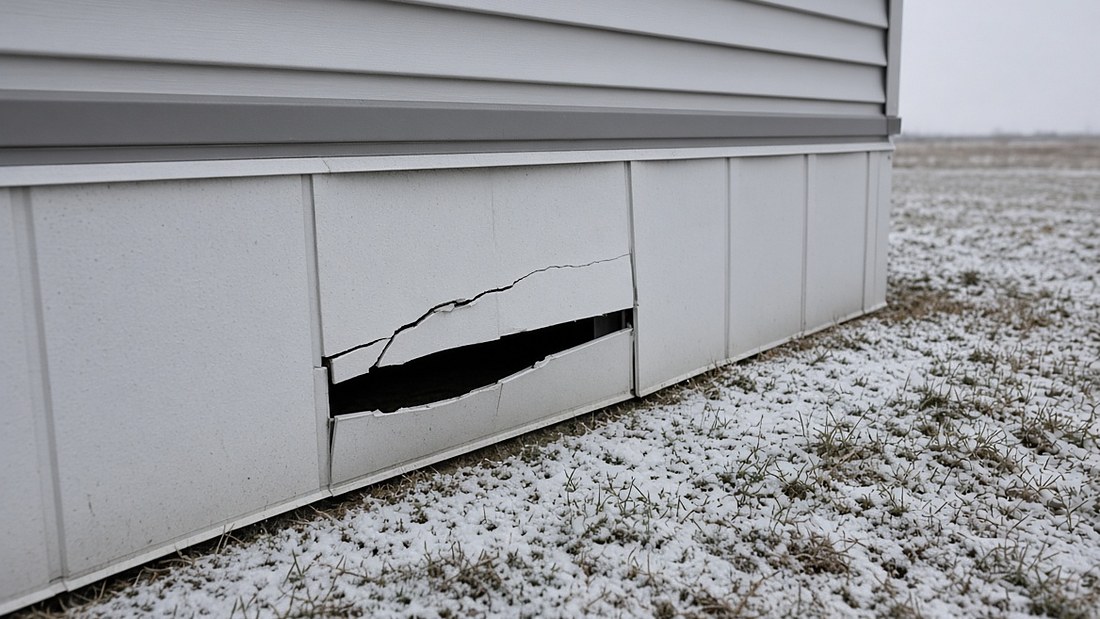
The difference is structural. In a site-built house the supply lines are inside walls, or under a floor with a foundation around them. In a manufactured home they run horizontally along the underside of the floor, inside the chassis, wrapped in the belly board — the fabric membrane slung underneath that holds the insulation up against the subfloor. Between those pipes and a January wind there is that membrane, and skirting. That is the whole of it.
Which means the annual job is not really plumbing. It is three walks around the outside of the house.
The October walk-round
Then there is heat tape, which on a manufactured home is not an exotic add-on but close to standard equipment, and this is where the warning on this page lands hardest. Of the heat-tape fires the Consumer Product Safety Commission counted, more than half involved mobile homes and trailers — and in its own investigations the agency found homeowners who did not know their home had heat tape under it at all.
So the first question is not how to maintain it. It is whether it is there, and how old. If you bought the home used, or inherited it, or simply have never been underneath, somebody else's cable may have been plugged in continuously for fifteen years. Find out before the cold, and read the heat tape section below before you buy, replace or extend any.
One honest note on sourcing. Nearly everything published about winterizing a manufactured home is written by somebody selling skirting, heat tape or parts, so we have kept this section to what is structurally true and to the one figure that comes from a federal agency. For your own home, the people worth asking are a plumber who works your park or your county and has been under a hundred of them.
🚽 The Other Pipes — Drains, Sewers and Septic
Everything so far has been about the pipes bringing water in under pressure. The pipes taking it away can freeze too, and almost nothing written about frozen pipes mentions them.
It is a different failure and it wants saying plainly. A frozen drain does not burst and flood the house. It backs up into it, which is its own kind of week.
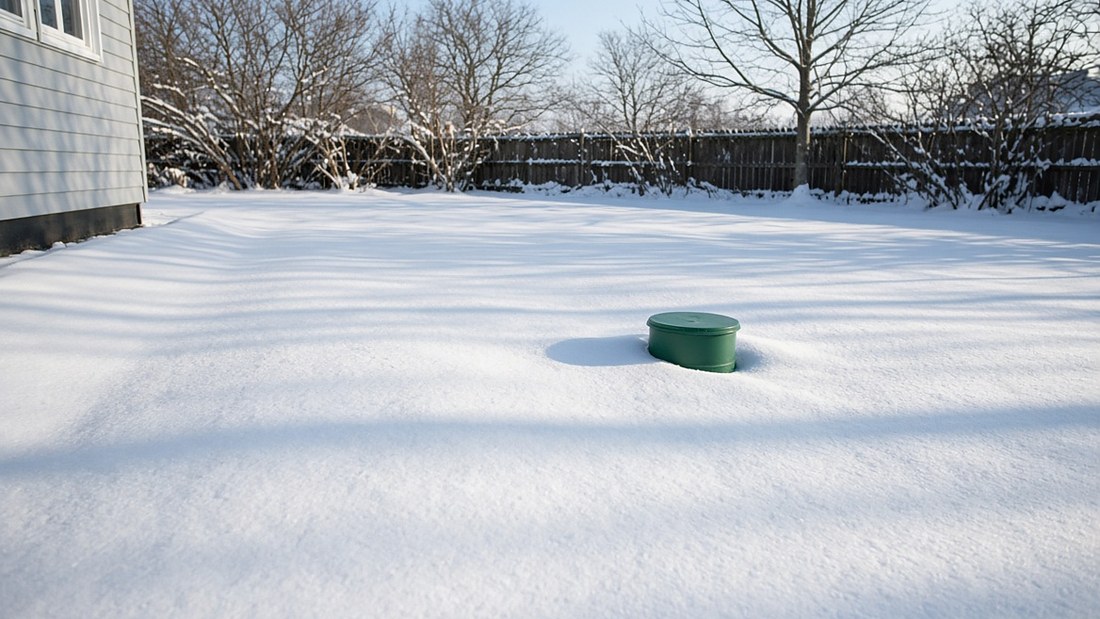
North Dakota State University Extension, which has more reason to think about this than most, lays out when it happens. A system that is used infrequently over the winter is the classic case. So is bare ground with no snow on it — and the reason is lovely: NDSU reckons ten inches of fresh fluffy snow is worth about six inches of fibreglass batt, somewhere around R-18. Snow is insulation, and a mild, dry, snowless cold snap is far harder on a buried line than a deep freeze under a foot of powder. A brand new system with bare soil over it commonly freezes in its first winter for exactly that reason.
The University of Minnesota's septic programme adds the causes that are built in rather than weather-driven: a line laid without enough fall, or one that has settled into a dip, so waste stands in the low spot instead of running through; and open, broken or uncapped inspection risers and manhole covers, which let cold air straight down into the system all winter.
What that means you can actually do
And a word for anybody on a city sewer who has just relaxed. The lateral running from your house to the main is the same pipe with a different owner at the far end, and the same shallow runs, the same dips and the same uncapped cleanouts apply to it. What changes is who pays to dig it up.
🚿 The Garden Hose That Splits a Pipe Inside Your Wall
If there is one job on this page that gets skipped more than any other, it is the garden hose, and if there is one failure that costs more than any other, it is the garden hose. Those two facts are the same fact.
Start with the two kinds of outdoor faucet, because most people do not know which one they own.
An ordinary hose bib shuts off right there at the wall. Turn it off and the water stops the instant you turn the handle. The short length of pipe between that valve and the open air has water sitting in it, and in a hard freeze that water turns to ice and cracks something.
A frost-proof faucet — also called a frost-free sillcock, and required in new work in most cold parts of the country — looks similar from outside but has a long body running back through the wall, so the valve that actually stops the water sits six to twelve inches inside, in the warm. Shut it off and the water in the cold outdoor stretch drains out through the spout by gravity. Nothing is left in the cold part to freeze. You can hear it happen: a frost-proof faucet dribbles for a few seconds after you shut it, and an ordinary one stops dead.
The whole design depends on being able to drain. A hose screwed onto the end is a plug in the only hole it has.
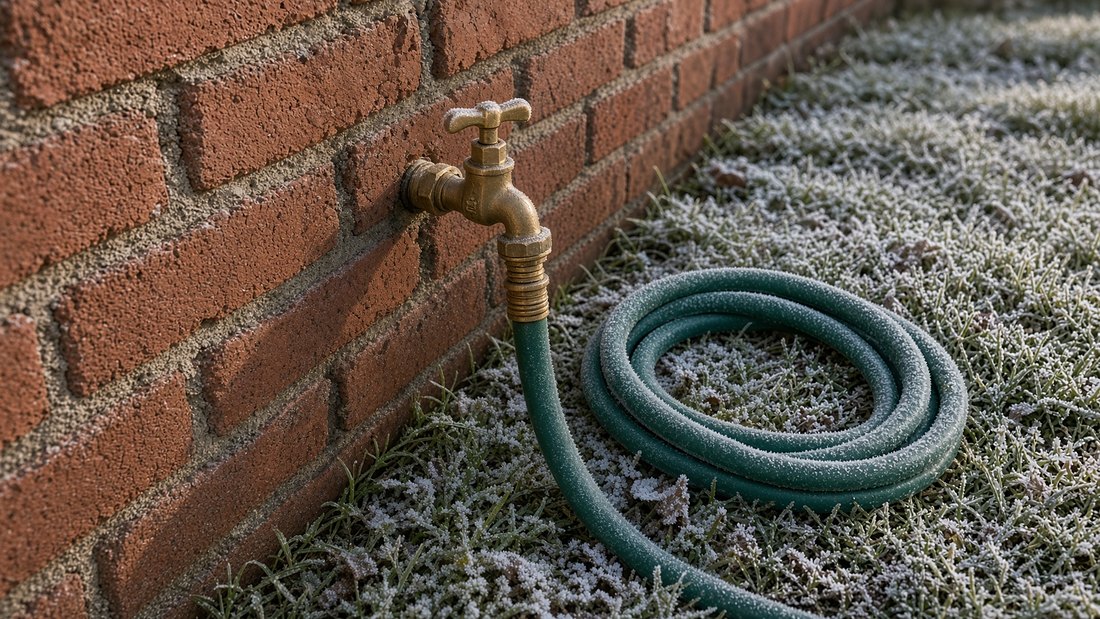
Woodford Manufacturing, which makes these faucets, spells the failure out in its own technical note, and it is worth having in order. With a hose or any other restriction left attached, the water cannot drain. The freezing works from the outside inwards along the faucet body. Once the ice has reached back into the faucet itself and the handle is shut, there is no relief from the expanding pressure — and eventually the tubing bursts to relieve it.
Then comes the part that makes this the expensive one. At the moment it bursts, nothing appears to have happened. There is no flood and no noise, because the ice is still plugging the hole. Woodford notes that only a few drops will weep through the split at the time. The water arrives later, when it thaws, and on a frost-proof faucet the split is on the long body inside the wall — so the first sign is often a wet ceiling below, or a stain that turns up in spring when somebody finally uses the hose again.
The autumn hose job
🍂 The Afternoon in October
Everything worth doing about frozen pipes is done on a mild afternoon months before, by somebody who is not cold, not hurrying and not in the dark. That is the whole argument of this site in one job.
The list is short and none of it is difficult.
Before the first hard freeze
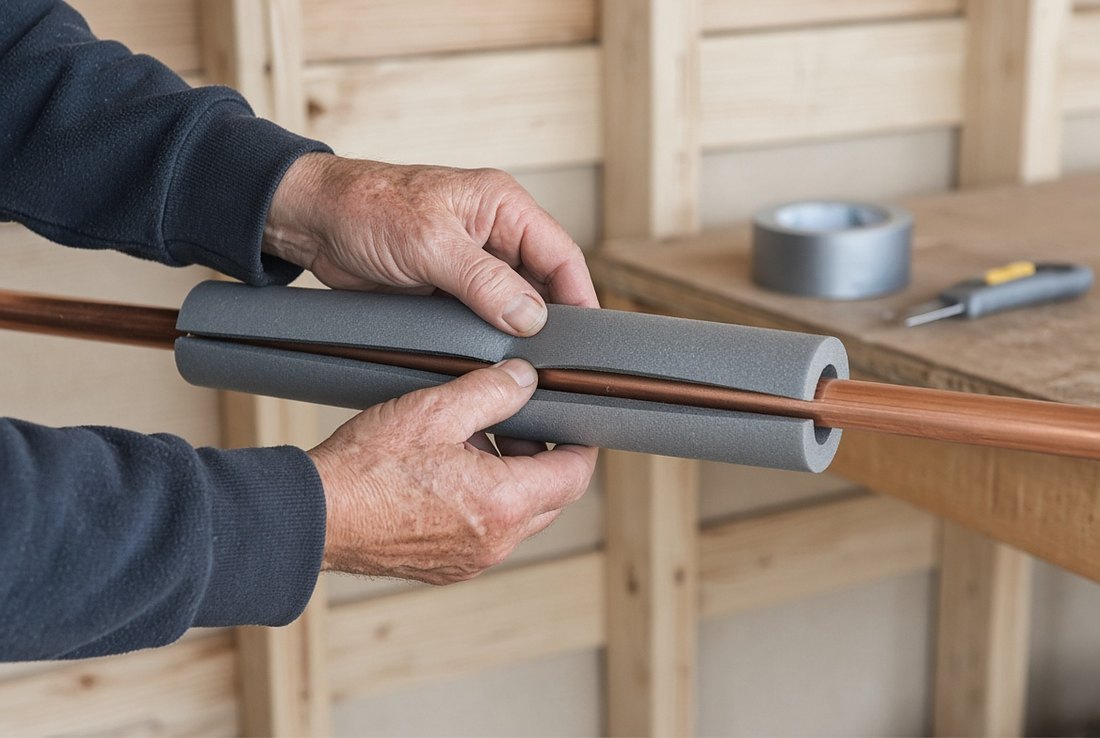
One note on newspaper, because it sounds like folklore and is not. The Red Cross says that even a quarter inch of newspaper wrapped round a pipe gives significant protection in places that do not usually get long spells below freezing. If you are in the South and a cold snap is two days out and the hardware store has sold out of foam sleeves — which is exactly what happens — that is a real answer and not a joke.
And if the same pipe freezes every year, the permanent fix is to have it moved or properly insulated by somebody who does that for a living. The Red Cross lists relocating exposed pipes as the last item on its own prevention list. It is a job for a remodel or a spring afternoon, not for February.
🌙 The Night It Is Coming
The forecast says the teens. Here is the whole of it, and it takes about ten minutes.
Ten minutes, the evening before
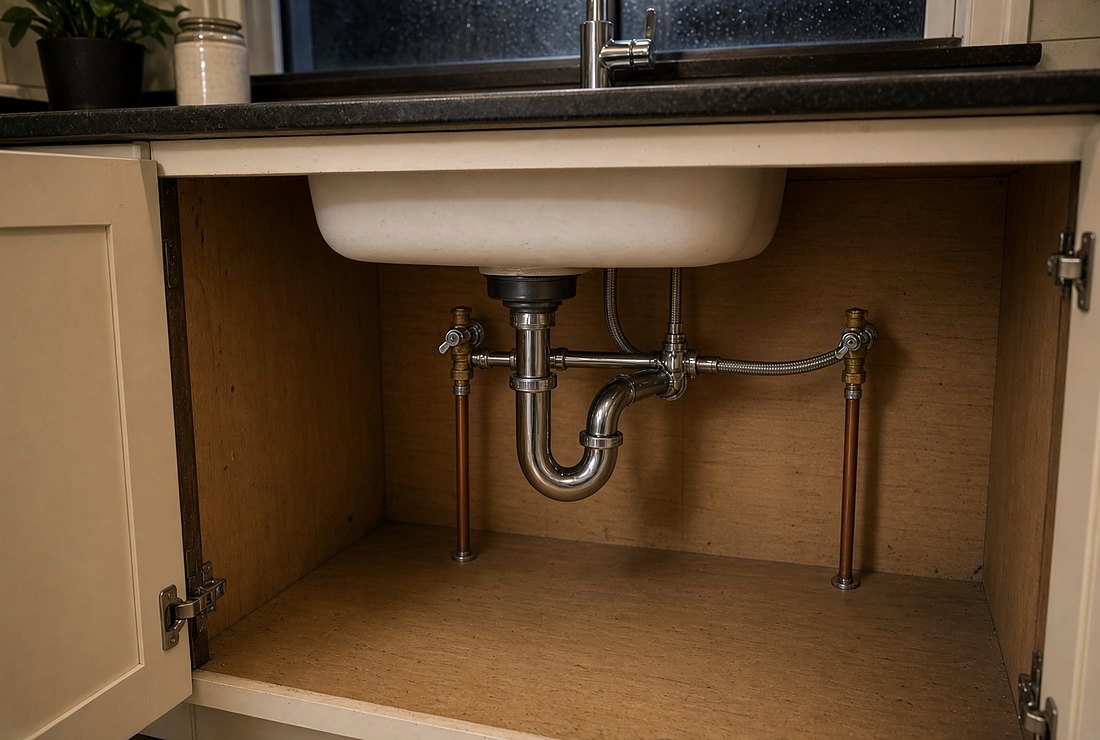
That last one deserves a word of its own, because it is the one that catches people who winter somewhere warmer. A house with nobody in it has nobody to notice the first trickle, and a split supply line runs at house pressure for as long as it takes for someone to walk in. If you are away for weeks rather than days, the honest answer is to have the water shut off at the main and the system drained by a plumber, and to have a neighbour with a key who actually goes inside.
There is one more thing that belongs on a winter checklist and gets missed because it is not a plumbing job at all: clear the snow away from your furnace vent and any other appliance vent on the outside of the house. A blocked vent on a cold night is a carbon monoxide problem, and the house that is warm enough not to freeze is the house everybody is shut inside of. We treat that properly on the one warm room page.
🔌 When the Heat Goes Off and Stays Off
Everything on this page up to here has quietly assumed something: that your furnace is running. Hold the thermostat steady, keep the cabinet doors open, let a tap drip — every one of those instructions needs a working heating system underneath it.
That assumption is exactly the one the rest of this site spends its time telling you not to make. Nearly every furnace in America needs electricity — for the ignition, the controls and above all the blower — so an ice storm that takes the power takes the heat with it, whatever is in the fuel tank. We go through that properly on the one warm room page. What nobody writes about is what it does to the plumbing, and the plumbing is on a clock from the moment the blower stops.
A house does not go cold quickly. A well-built one holds usable warmth for most of a day, and a badly built one can be down near outdoor temperature inside twelve hours. But the direction is one way, and the pipes in the crawlspace and the garage and the outside walls get there long before the living room does.
There comes a point where you stop trying to protect the pipes and start emptying them instead. Knowing where that point is, before you are standing in the dark trying to decide, is most of the battle.
Roughly, the point is this: when the heat has been off for a day or more, the forecast is not lifting above freezing, and nobody can tell you when the power is coming back. A drip will not save you once the house itself is heading for thirty degrees. What saves you then is that there is nothing left in the pipes to freeze.
Draining a house, in the order Purdue Extension gives it
This list is adapted from Purdue University Extension's guidance on protecting plumbing during a winter power failure, which is the clearest published version of it we found.
The sequence
There is a tenth item and it is the one people forget, because a drain trap does not look like plumbing that can break. Every trap in the house is holding a cupful of water in a U-bend, and they are cast or moulded, not flexible. Purdue's method is to empty them by pulling the drain plugs or disconnecting them, blow out what you cannot reach, or put propylene-glycol antifreeze in each one — roughly the volume of the trap, a pint to a quart depending on size. Kitchen and bathroom sinks, tubs, showers, the toilet bowls, washtubs, floor drains and the sump.
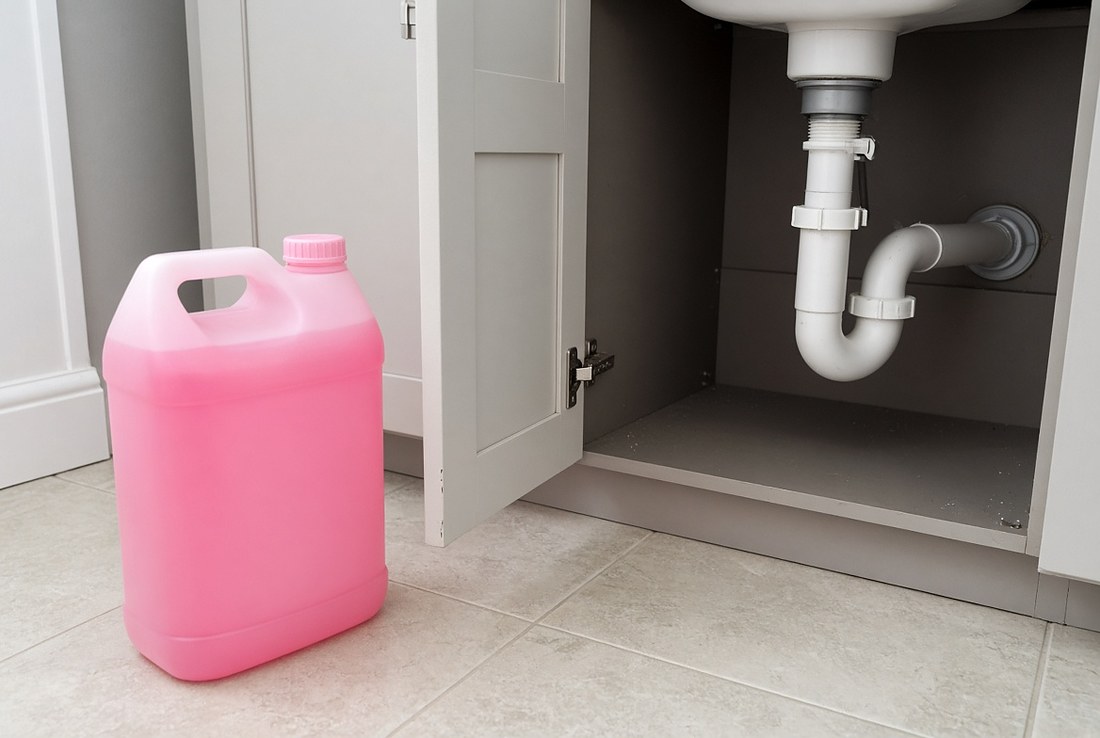
The antifreeze distinction matters and getting it wrong is dangerous. Propylene glycol is the pink non-toxic kind sold for winterizing camper vans and boats. Ethylene glycol — ordinary automotive antifreeze — is poison, it is sweet, it kills pets and wildlife, and it has no business in a drain, a septic tank or anywhere near a person. The Red Cross says the same about putting antifreeze in pool and sprinkler lines: do not, unless the installer has told you to. And none of it, ever, goes into a supply line you are going to drink out of.
Now the honest part. That is nine or ten jobs, several of them on your knees, some of them in a crawlspace, in a house with no power and no heat, probably by torchlight. Read it as a description of what has to happen rather than a list of what you personally must do. If the answer is that you cannot, the answer is a plumber, and the time to find out which plumber is a mild afternoon in October — ring two, ask what they charge to winterize a house, and write the number where you can find it in the dark. Getting drained out and turned back on again in the spring costs a fraction of one burst line.
And the version of all this that requires nothing from you at all: if you are leaving before the storm rather than sitting through it, shut the water off at the main on your way out of the door. It is thirty seconds, it does not empty the pipes, and it means that whatever splits while you are gone stops after a few gallons instead of running for a fortnight.
🔧 The Valve You Have Never Turned
A burst pipe is a plumbing problem for about four seconds. After that it is a water problem, and the only thing in the world that solves a water problem is the valve that turns the water off.
So the question is not whether you know roughly where your main shutoff is. The question is whether you have put your hand on it, turned it, and watched it stop the water — because a valve that has not moved in twenty years very often does not want to, and finding that out at two in the morning with the ceiling coming down is finding it out at the worst possible price.
Go and do it on a dry afternoon. Find the valve. Turn it off. Go and open a tap and watch it die. Turn it back on. That is the entire exercise and it takes five minutes, and it is the difference between a wet patch and a wet house.
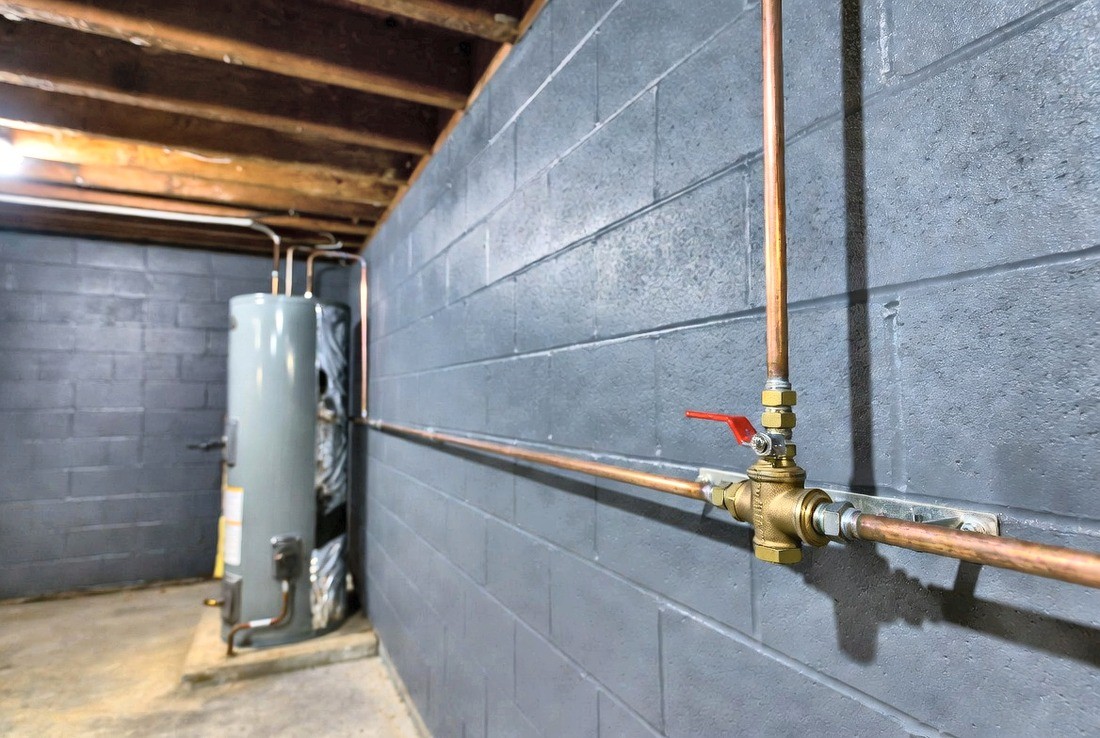
Where it is depends on the house again. In a basement it is usually on the wall where the main comes in, often near the water heater. On a slab it may be in a closet, in the garage, or on the outside wall — and in a good many slab houses there is no interior main at all, and the only shutoff the house has is the one in the meter box out by the street. That is not a defect, it is how they were built, and it is the reason a meter key is a tool worth owning.
We have a whole page on this — which valve in the meter box is actually yours, why you have to ring the water utility once to find out, and why forcing a stiff one snaps the operating nut. Water, gas and electric shutoffs covers all three, and it is the page to read alongside this one.
Two more things about that night, and both of them are about not making it worse.
If a pipe has already burst and there is water on the floor, do not operate electrical appliances while you are standing in it, and do not go poking around a panel that is wet. And once the water is off at the main, leave the taps open so the system drains and whatever pressure is left has somewhere to go.
🚫 Nothing Comes Out of the Tap
You turn the handle on a cold morning and you get a trickle, or you get nothing. That is a frozen pipe until proven otherwise, and you have some time but not a great deal.
Work in this order.
What to do, in order
The flat no, and it is the Red Cross's own list: no blowtorch, no kerosene or propane heater, no charcoal stove, no open flame of any kind. Two separate reasons, and each on its own is enough. A blowtorch can boil the water inside the pipe and burst it — you are not thawing it, you are pressurising it. And every open flame indoors brings fire risk and lethal carbon monoxide into a house where the windows are shut against the weather.
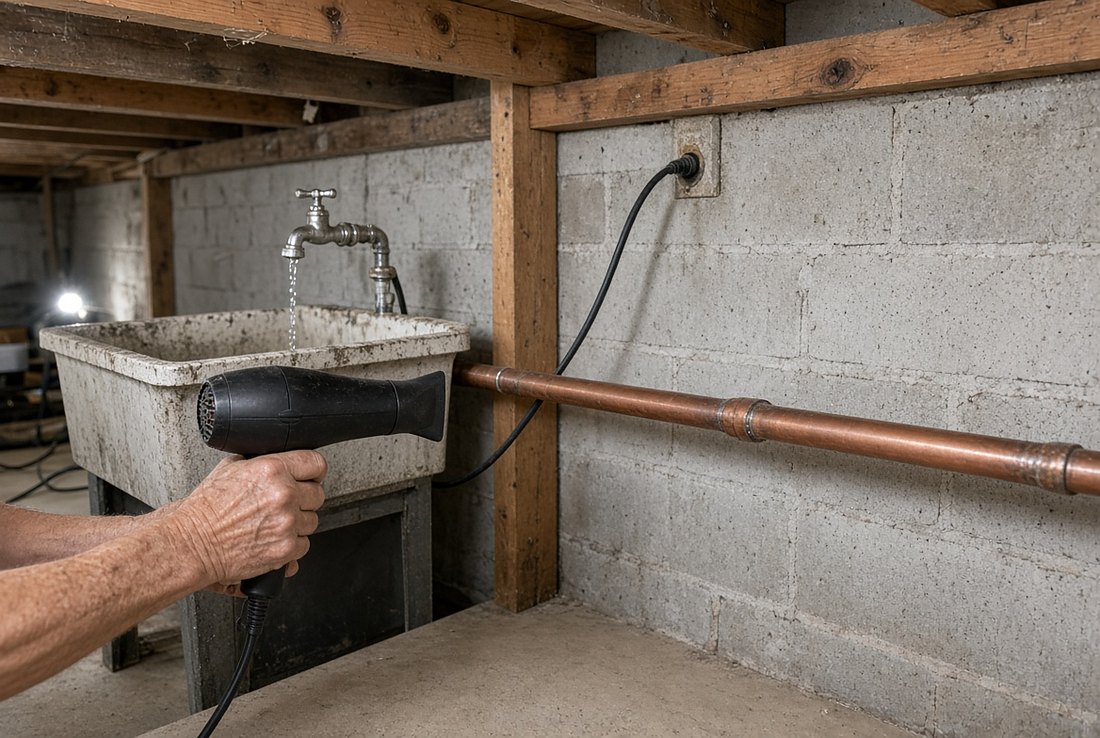
One more caution that belongs to this audience specifically. A heating pad, a hair dryer and a length of extension cord in a wet basement or a crawlspace is an electrical situation as well as a plumbing one. Keep every one of those things out of contact with water, and if the pipe you are trying to reach means crawling under the house on a January morning, that is the moment to consider whether this job is yours.
Because the honest answer is sometimes no. If you cannot find the frozen stretch, cannot get to it, or cannot thaw it, the Red Cross says call a licensed plumber, and so do we. So does the discovery of an actual split — a bulge, a crack, water weeping through. At that point the job is turning the water off and picking up the telephone, and there is nothing undignified about it.
💧 Turning the Water Back On — and Finding What You Cannot See
This page has now told you twice that a pipe can split while it is frozen and give you no sign at all — the ice is still plugging the hole, and the faucet maker's own note says only a few drops weep through at the time. Which leaves an obvious question that most writing on this subject never gets round to answering. How do you find out?
The answer is that you go looking on purpose, on a day when you are home and awake, rather than finding out at two in the morning a week later.
Bringing the water back
The order
The meter test, which finds the leak you cannot see
This is the one that settles it, and it costs nothing. Almost every residential water meter has a leak indicator on the face — Portland's water bureau describes it as a small triangular dial, red or blue, or sometimes a blue snowflake shape. It is geared to be sensitive: it spins briskly when water is running and turns slowly when water is merely dripping.
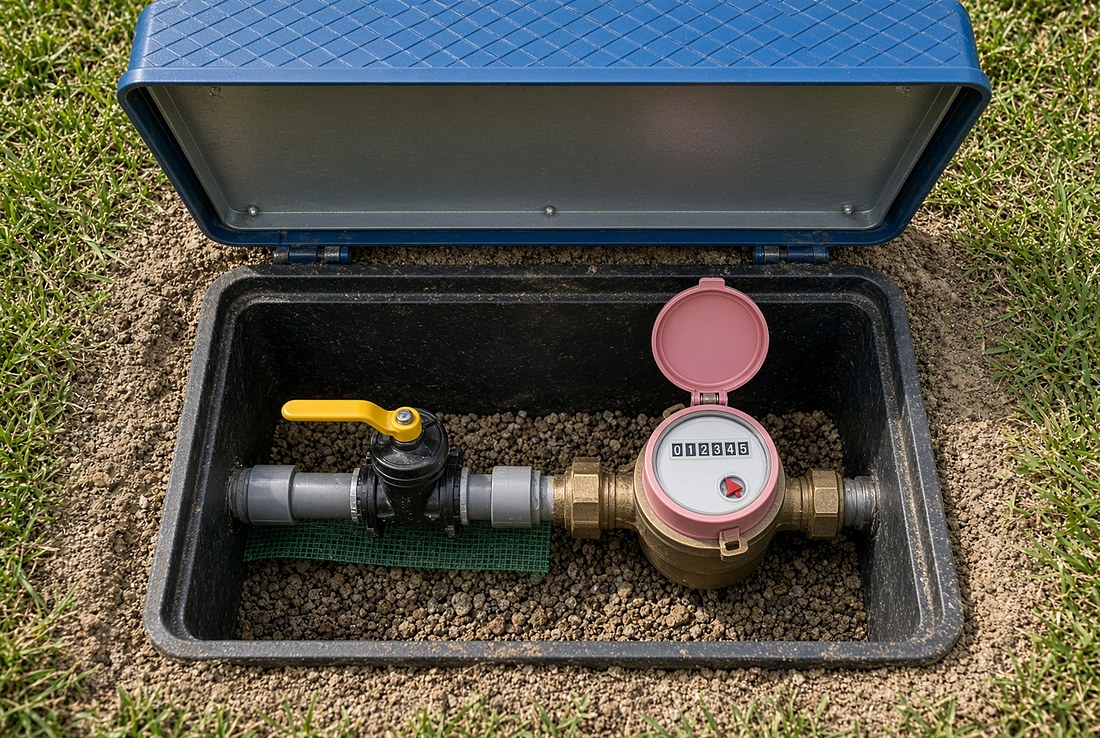
So: turn off every tap, every appliance that takes water, the ice maker, the humidifier, anything on a timer outdoors. Leave the main valve open — you want water able to flow. Then go and look at the meter.
If that indicator is turning and nothing in the house is running, water is going somewhere it should not be. If it is dead still, do the slow version: East Bay Municipal Utility District's method is to lay a toothpick on the meter face lined up exactly with the dial, or simply photograph it with your phone, then come back in thirty minutes and see whether anything moved. That catches the drip too slow to spin anything.
There is a longer version of the same test, using the reading rather than the dial, on our plumbing repairs page — read the numbers, leave it two hours with nobody using water, read them again.
And one bonus the test gives you for free: if the indicator keeps turning after you shut the main valve at the house, the leak is between the meter and the building — in the buried service line rather than in your plumbing. That is a different repair, a different conversation, and in some places a different owner.
A burst you find in March, with the water off and a plumber booked, is a repair. The same burst found by a ceiling is a room.
⚡ Heat Tape — the Fix That Starts Fires
Electric heat tape, also sold as pipe heating cable, is a length of heating element you wrap along a pipe and plug into an outlet. Under a mobile home, in a crawlspace, along a vulnerable run in an unheated space, it is often the only practical answer, and it is on the Red Cross's own list of things to consider — with the words UL-listed attached.
It is also the only item on this page with a body count attached to it, and the reader deserves that straight.
The Consumer Product Safety Commission has issued a run of safety alerts about heat tape over the years, drawn from federal fire data. Its estimate was about 3,300 residential fires a year involving heat tapes or cables, causing around 20 deaths, 160 injuries and $25 million in property damage. Over half of those fires involved mobile homes and trailers. In its investigations the agency found that many homeowners never inspected their heat tape at all — and that in some cases, people did not know their house had any.
Where that number comes from, honestly: those CPSC figures come from the agency's own heat-tape safety alerts, and they are old — the releases date from the late 1980s and 1990s, and the agency has since said it no longer collects data specifically on heat-tape incidents. Treat them as the right order of magnitude rather than this year's count. What has not aged at all is the list of things that cause the fires, because the product works the same way it always did.
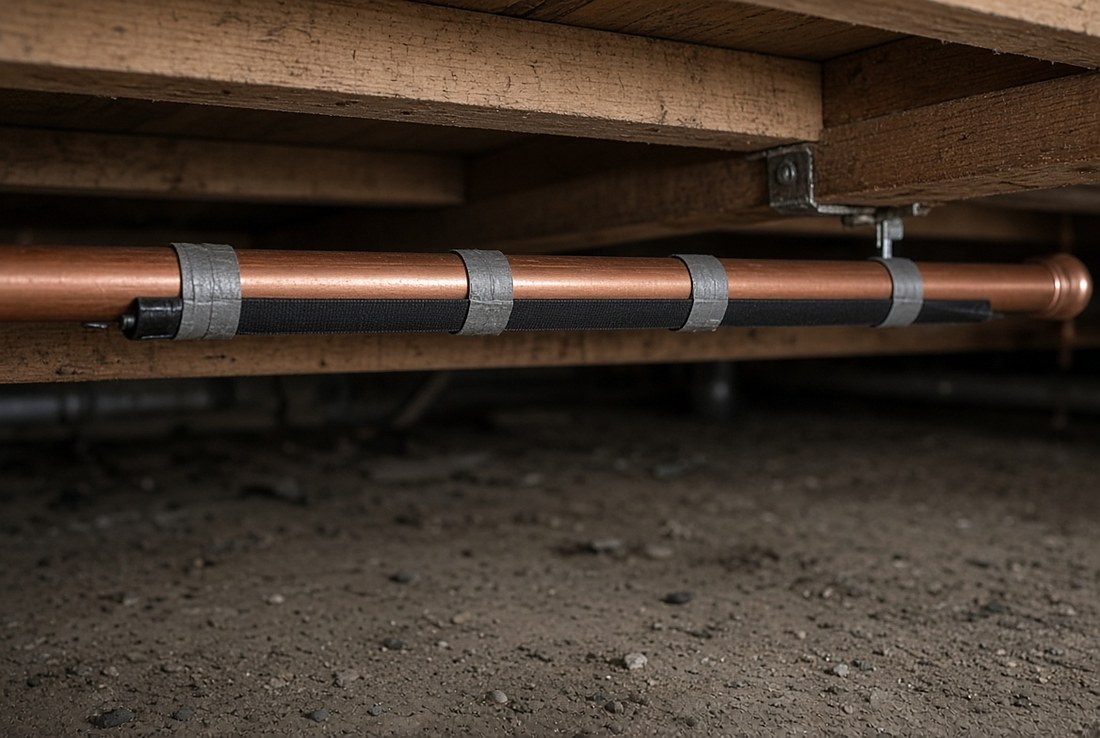
That list, from CPSC, is short enough to follow and specific enough to matter:
What CPSC says about heat tape
And the one that is specific to the people this site is written for: CPSC says outright that most consumers should have heat tape in a crawlspace or under a mobile home inspected by a qualified electrician rather than doing it themselves. That is not a judgement about anybody's competence. It is a judgement about where the tape lives — on your back, in the cold, under a house, with a flashlight, looking closely at wiring. There is a version of this job that you can do standing up in a garage, and a version that belongs to somebody with knee pads and a trade.
If you moved into the house and have never been underneath it, the thing to find out first is whether there is heat tape down there at all, and how old it is. Somebody else's twenty-year-old cable, plugged in year-round and forgotten, is the exact situation those fire figures describe.
🔑 If You Rent
Read back over this page and notice what nearly every instruction on it assumes: that you own the building and may do as you like to it. Take the hose off, sleeve the crawlspace, drain the system, turn the main. Somebody renting an apartment, a condo or a house can do almost none of that, and nobody writes the other version.
So here it is. It is shorter, and it is mostly about two things — the few measures that are genuinely yours, and getting the problem on the record before it becomes a burst pipe rather than after.
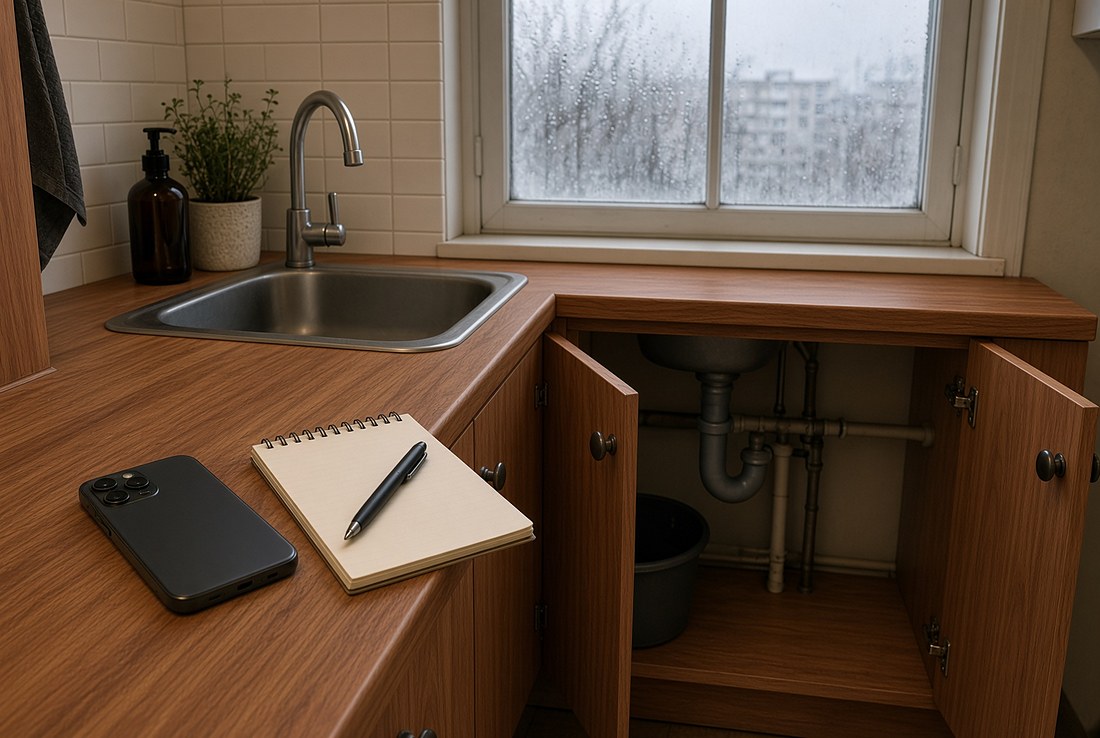
What is actually within your control
Where you stand on heat, in general terms
Heat is the part with law attached to it, and the shape of that law is worth knowing even though the detail is local.
There is no federal rule setting a temperature for a private landlord. Housing is a matter of state and local law. The Department of Housing and Urban Development does publish standards requiring a heating system in working order — but those Housing Quality Standards apply to units receiving federal housing assistance, not to rentals generally.
What nearly every state does have is the implied warranty of habitability: a doctrine, adopted by most states through their courts or their statutes, that a rented home must be fit to live in — and working heat has consistently been read as part of that. On top of it sit local housing codes, and a great many towns have adopted the International Property Maintenance Code, a model code whose heating-season requirement is a minimum of 68 degrees in habitable rooms.
Cities then write their own, and they differ. New York City's heat season runs the first of October to the thirty-first of May, with 68 degrees required during the day when it is below 55 outside and 62 at night. Chicago's runs from mid-September to the first of June at 68 by day and 66 at night. Those are examples of how specific the rules get, not the rule where you live. The number that governs your apartment is written by your own city or county, and the office that enforces it is your local code enforcement or housing department.
One thing that is true nearly everywhere: a landlord shutting off heat, water or power to pressure a tenant into leaving, or to punish them for complaining, is illegal in virtually every state. If that is what is happening, it is not a maintenance dispute and it is not something to negotiate about — it is a call to your local housing authority or code enforcement office.
And none of the above is legal advice. We are not lawyers, this is a general description of how the rules are shaped, and landlord and tenant law varies by state, by city and over time. If the heat is off and the landlord will not act, the people to ring are your local code enforcement office, your state or city tenant advice line, or a legal aid organisation — and for anybody over sixty, the Eldercare Locator can point you at free legal help in your own county.
❓ Questions People Ask
At what temperature do pipes freeze?
Around 20°F outdoors, not 32°F. Field tests by the Building Research Council at the University of Illinois found that uninsulated pipes in an unheated attic began to freeze when the outside temperature fell to 20°F or below, and that figure is now widely published as the temperature alert threshold. A pipe in a draughty spot, or one with wind blowing on it, can freeze above that.
Does leaving a faucet dripping really stop pipes from freezing?
It does not stop the water freezing. It stops the pipe bursting, which is the part that matters. The split is caused by pressure building between an ice plug and a closed faucet, so an open faucet gives that pressure somewhere to go. The slowest drip at normal house pressure is enough, and only the taps fed by pipes in cold spaces need it.
Where does a frozen pipe usually burst?
Usually not at the ice. The ice forms a plug, then water trapped between that plug and a closed faucet is squeezed until something gives, so the split commonly appears on a stretch of pipe with little or no ice in it at all.
Why do I need to take the garden hose off before winter?
Because a hose left screwed on stops the faucet draining. Woodford Manufacturing, which makes frost-proof outdoor faucets, states that when a hose or other restriction is left attached the water cannot drain out, the faucet freezes from the outside inwards, and with the handle shut there is no relief from the expanding pressure until the tubing splits. On a frost-proof faucet that split is inside the wall.
How do I thaw a frozen pipe safely?
Leave the faucet open, then warm the pipe gradually with an electric heating pad, a hair dryer, hot wet towels, or a space heater kept well away from anything that burns, working from the faucet end back towards the cold. The American Red Cross says never to use a blowtorch, a kerosene or propane heater, a charcoal stove or any other open flame: a blowtorch can boil the water inside and burst the pipe, and open flames indoors bring fire and carbon monoxide with them. If you cannot find it, cannot reach it or cannot thaw it, call a licensed plumber.
Is it safe to leave the heat off while I am away in winter?
The American Red Cross says to leave the heat on and set no lower than 55°F if you are going away in cold weather, and to hold the thermostat at the same temperature day and night rather than letting it drop overnight. A higher heating bill is the cheaper of the two outcomes.
Is PEX pipe freeze-proof?
No. PEX is flexible enough to swell a little and recover, which makes it the most freeze-tolerant of the common materials, and the Plastics Pipe Institute publishes research saying so. But a CPVC manufacturer's rebuttal makes two fair points: PEX burst in quantity during the February 2021 Texas freeze, and the tests are run on new pipe rather than pipe that has aged in chlorinated water. Both of those companies sell pipe. What they agree on is the useful part: every material bursts under enough ice pressure, and the fitting usually goes before the pipe does.
Should I drain my pipes if the power goes out in winter?
If the heat has been off for a day or more, the forecast is not rising above freezing, and nobody can say when the power is coming back, then yes. Purdue University Extension's order is: water off at the main or the well pump off, kill the breaker to an electric water heater before anything drains, drain the pressure tank if you are on a well, open every faucet, drain the low points, empty the toilet tanks, disconnect the water softener, wrap whatever will not drain, and drain the appliances. The drain traps want emptying or filling with propylene-glycol antifreeze, never the automotive kind.
How do I know if a pipe burst while it was frozen?
You often cannot tell by looking, because the ice plugs the split and only a few drops weep through at the time. Bring the water back on deliberately, on a day you are home: open the faucets, open the main slowly, then walk the house looking under sinks, at ceilings below pipe runs and in the crawlspace. Then run the meter test. Turn everything off, leave the main open, and watch the leak indicator on the water meter, which is usually a small red or blue triangle. If it turns with nothing running, water is escaping somewhere.
What can I do about frozen pipes if I rent?
Open the cabinet doors, run the drip, keep the heat on even when you are away, and find out now who shuts the water off in your building and what number reaches them at night. Report a cold wall or a room that will not warm up in writing, early, because that is what protects you later. Do not start thawing or repairing somebody else's plumbing yourself. Heat is usually covered by your state's implied warranty of habitability and by your own city's housing code, and the office that enforces it is local code enforcement.
💰 Why This Is a Fifty-Year-Old's Errand
Look back over this page and sort the jobs by what they ask of a body.
Unscrewing a hose is nothing. Opening a cabinet door is nothing. Setting a tap to drip is nothing. Holding the thermostat steady is nothing at all — it is a decision, not a task, and you can make it from a chair.
Then there is the other half. Getting into a crawlspace to sleeve a pipe. Going up into the attic in October with a bag of foam and a caulk gun. Kneeling at a valve that has not turned since the Clinton administration and leaning on it. Getting under a mobile home to look at a cable. Those are the ones that quietly stop being available, and they do not announce the day they go.
The work is cheap and the timing is everything. A twelve-dollar bag of foam sleeves fitted at fifty-five is still working at seventy-five. Fitted at seventy-five, it is a job somebody has to be called about.
Which is the whole of this site in one paragraph, and why the frozen pipe is such a good example of it. Nothing on this page costs much. The hoses are free to take off. The caulk is twenty dollars. The pipe sleeves are a few dollars a length and they last as long as the pipe does. The expensive part was never the materials — it is the afternoon, and the afternoon gets harder to find every year.
There is one purchase on this page that did not exist when most readers bought their houses, and it deserves naming. A freeze alarm is a small temperature sensor that watches the house and tells you when it drops — usually around forty or forty-five degrees, which is well before anything is in danger. The plain ones dial a telephone number. The modern ones send a message to a phone, and most of them will also tell you the power has failed, because losing power is the thing that made the house cold in the first place.
Who this is actually for. Anybody who leaves a house standing in winter — which in this country runs in both directions. Northerners who come south for the season and leave a house behind, and southerners who go north in the summer and leave one here. It is also for people who have a cabin, a rental, a place a parent lived in, or simply a basement they do not go down into every day. Forty degrees and falling is a telephone call. Twenty degrees with the ceiling down is a contractor.
It is not a substitute for a neighbour with a key, because a message telling you the house is at thirty-eight degrees is no use at all if nobody can get in. It is the thing that tells the neighbour it is time to go. Pair the two and you have covered the case this page cannot otherwise reach: a cold house with nobody in it.
So the errand is this. On the next mild weekend, before the first hard freeze, go round the house once with the list. Take the hoses off. Sleeve the cold runs while you can still get to them. Fill the holes the wind comes through. And go and turn that main shutoff, so that the one night you need it, it is a valve you have already turned instead of a valve you are meeting for the first time.
Do that once a year and the twenty-degree night is a night you sleep through.
And while you are out there with the list: the same cold snap puts ice on the path between your door and the car, which is its own subject — boots that actually grip, and the shoveling question worth asking your doctor.
Sources: the twenty-degree temperature alert threshold, the attic field tests and the survey of seventy-one southern plumbers come from research by the Building Research Council at the University of Illinois, published by the Insurance Institute for Business & Home Safety. Prevention, protection and thawing guidance is from the American Red Cross fact sheet on preventing and thawing frozen pipes. The frost-proof faucet failure sequence is from Woodford Manufacturing's own technical note on how a standard frost-proof faucet works. Heat tape fire estimates and installation guidance are from U.S. Consumer Product Safety Commission safety alerts, with the caveat about their age stated on this page.