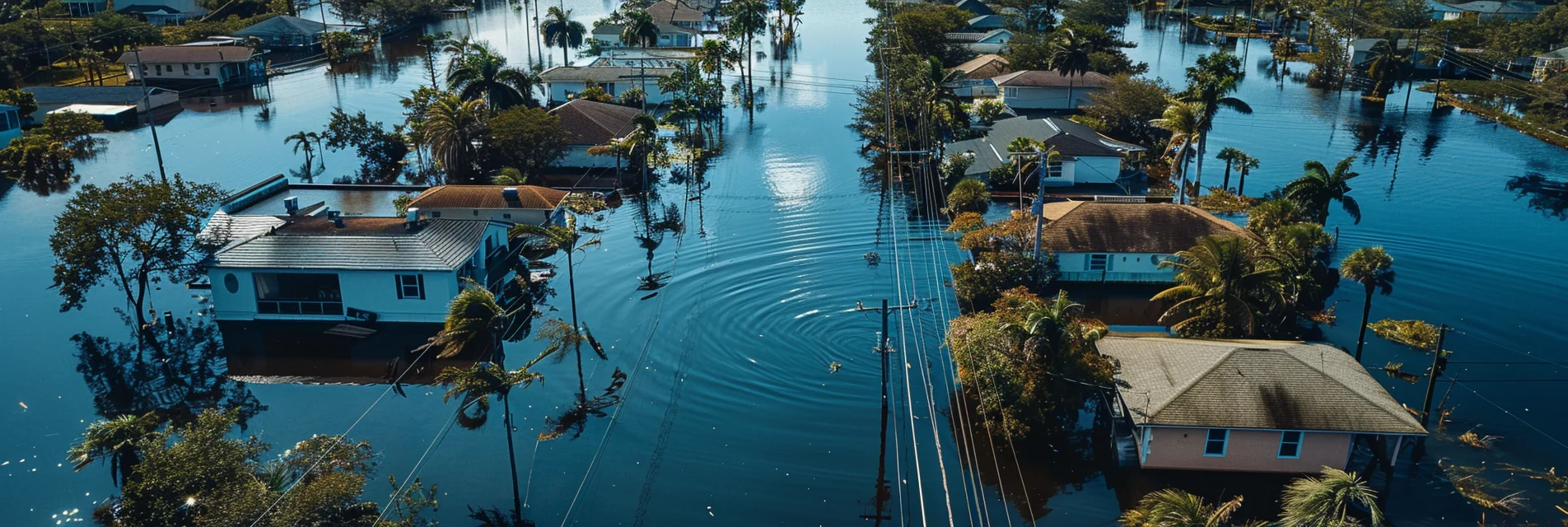
Florida's High-Velocity Hurricane Zone counties — Miami-Dade and Broward — require Florida Product Approval on every roofing material. The strictest roofing codes in the nation apply here. Statewide, the 2020 Florida Building Code (7th Edition) governs installation. Wind-mitigation inspections are separate from damage inspections and can reduce your annual premium by hundreds of dollars.
Storm damage on Florida roofs
After a Florida storm, the most expensive damage is often invisible from the ground. Here is what a licensed inspection finds.
Wind uplift breaks shingle seals across entire roof sections simultaneously. Hail bruises the mat beneath the granule surface — damage that shows up years later, not immediately. Flashing around chimneys, valleys, and penetrations loosens under sustained wind pressure, creating water pathways that don't appear as ceiling stains until weeks after the storm.
Florida's 1,600+ annual UV hours, 54 inches of average rainfall, and salt-air corrosion accelerate granule loss and fastener wear even between storm events. Pre-storm documentation of roof condition is your baseline for every future claim.
🌀 Recent Florida storm benchmarks — official OIR data
According to the Florida Office of Insurance Regulation: Irma (2017) generated 1,125,588 claims and $20.7B in insured losses — the largest claim count of any Florida storm. Ian (2022) generated 789,066 claims and $22.2B in losses — Lee County alone had 283,003 claims. Milton (2024) generated 385,146 claims and $5.6B in losses. Michael (2018) generated 158,991 claims and $9.1B in losses across the Panhandle. See full claims data by storm and county →
Coastal roof types & how they hold up in Florida
The right roof for a Florida coastal home balances wind rating, cost, and local climate exposure.
Architectural shingle
Most common statewide. Storm-rated Class 4 impact shingles are recommended coastally. Quick to repair, widely available, and eligible for wind-mitigation credits.
Metal roofing
Excellent for Florida's salt air and sustained hurricane winds. Standing seam earns the highest wind-mitigation inspection scores and qualifies for significant premium discounts.
Tile roofing
Classic Florida aesthetic with outstanding durability. Heavier; requires structural review after any impact damage. Especially popular in South Florida and coastal markets.
📋 Florida building code overview
Miami-Dade and Broward HVHZ require Florida Product Approval on all roofing materials. Statewide, the 2020 Florida Building Code 7th Edition governs installation. Wind-mitigation inspections — separate from damage inspections — document roof shape, deck attachment, and opening protection for insurer premium credits.
2026 roof repair & replacement ranges
Ranges reflect 2026 quotes from licensed Florida roofers. HVHZ counties (Miami-Dade, Broward) typically run 15–25% above state average due to Florida Product Approval material requirements.
| Roof work | Typical range | Best for |
|---|---|---|
| Minor storm repair | $400 – $1,500 | A few shingles, small leaks, flashing |
| Section / slope replacement | $1,500 – $6,000 | Localized wind or hail damage, one slope |
| Full roof replacement | $9,000 – $28,000+ | Widespread damage, Ian-level events, aging roof |
HVHZ counties run higher due to mandatory Florida Product Approval materials and enhanced installation requirements. Wind-mitigation upgrades often pay back through annual premium savings.
Your roofing product or service here. Reach homeowners actively comparing storm-damage roofing options across 13 coastal states. High-intent audience, zero waste.
Storm roof claims in Florida
Wind and storm damage is covered in Florida — but claims move on a strict clock and live or die on documentation.
Florida law requires insurers to acknowledge claims within 14 days and pay or deny within 90 days. Adjusters need dated evidence tying damage to a specific storm — a professional inspection provides exactly that. Florida's Assignment of Benefits (AOB) laws changed in 2023; understand your policy before signing anything with a contractor.
💰 Wind-mitigation discounts in Florida
Florida's wind-mitigation inspection program allows homeowners to receive premium discounts for qualifying roof features. Roof shape, deck attachment method, opening protection, and roof covering type all factor in. Most Florida homeowners with newer or upgraded roofs save $500–$2,000 annually. The inspection takes 1–2 hours and pays for itself in the first year.
Work the numbers before the adjuster does. The coinsurance calculator and the hurricane deductible calculator between them explain most of the gap homeowners find between what a roof costs and what a policy pays.
What to do once it's safe
Stay safe & tarp if needed
Don't climb a damaged roof. Cover active leaks from inside and call a pro for emergency tarping if water is actively entering. Step-by-step tarp guide →
Document everything with dates
Take dated photos of all visible damage — roof surface, ceilings, walls, attic, and any affected belongings. Date and timestamp are critical for claim correlation.
Hire a licensed roofer to inspect
A licensed local roofer assesses hidden damage — shingle seal failure, deck saturation, flashing separation — and produces a written report for your claim.
File within your window
Submit your claim promptly with the inspection report. Florida law requires insurers to pay or deny within 90 days. File as soon as possible — earlier documentation always produces stronger outcomes.
Florida's claim clock starts the day the storm hits — don't wait
Florida's storm season runs June through November. Florida law sets strict claim acknowledgment deadlines — and adjusters are under pressure to close files fast after major events. A licensed inspection the week after a storm is dramatically stronger than one filed months later.
How to verify a roofer in Florida
After any major storm, unlicensed contractors target affected neighborhoods. Here is how to protect yourself.
Florida roofing contractors must hold a Certified Roofing Contractor (CRC) or Registered Roofing Contractor (RRC) license from the Florida DBPR. Verify any contractor at myfloridalicense.com/DBPR before signing. After major Florida storms, out-of-state storm chasers flood the market — always verify active licensure and local business presence.
Verify state license
Check the state licensing board before signing anything.
Confirm insurance
Ask for a certificate of liability and workers' comp.
Use a local roofer
Local contractors know your county's permit process and are accountable after the job.
Licensed & insured
Independent, ad-supported storm-damage roofing guidance for Florida homeowners — local codes, damage documentation, and how to vet a contractor yourself. Roofing companies may advertise here, clearly labeled.
State licensed
Contractors advertising here represent themselves as state-licensed. Always verify before signing — check myfloridalicense.com ↗
Fully insured
Contractors represent themselves as carrying liability and workers' compensation insurance. Ask for certificates and verify before signing.
Local experience
Pros who know Florida code, your county's permit office, and local claim patterns.
Florida counties we cover
Pick your county for its local storm history, HVHZ status, 2026 pricing, and licensed roofers near you. Each county page lets you drill down to your city.
How to hire a licensed Florida roofer
StormRoofQuotes is an independent, ad-supported information resource. We don't arrange inspections or refer you to any contractor — the guides below explain how to document damage and hire a licensed local roofer yourself.
StormRoofQuotes is an independent, ad-supported information resource. We publish storm-recovery guides and clearly-labeled roofing advertisements. We do not arrange inspections, take commissions, or refer you to any contractor.
How this site works →