Why reactive repair costs 4–5x more than planned maintenance
Emergency roof repairs carry a 4–5x cost premium over planned repairs. A commercial roof maintained properly can reach 25 years of service life — the same roof replaced at 10 years due to undetected damage represents $80,000 to $500,000+ in unnecessary capital expenditure, according to a 2026 commercial maintenance guide by OxMaint.
The core equation: a biannual professional inspection for a 20,000 sq ft commercial building costs $600–$1,600 per year in inspection fees. A single interior water damage event from a small membrane failure — fully preventable with routine inspection — typically runs $10,000–$40,000 in combined repair and remediation. The ROI calculates itself.
📋 2026 Insurance Requirement — Read This First
Many commercial property insurance carriers now make documented inspection history a coverage condition. No records of professional inspection in the 12 months preceding a storm means your carrier has grounds to reduce or deny the claim, arguing the damage was from deferred maintenance rather than the storm event. A maintenance program isn't just an ROI play — it's a claims protection strategy.
What a professional commercial roof inspection covers
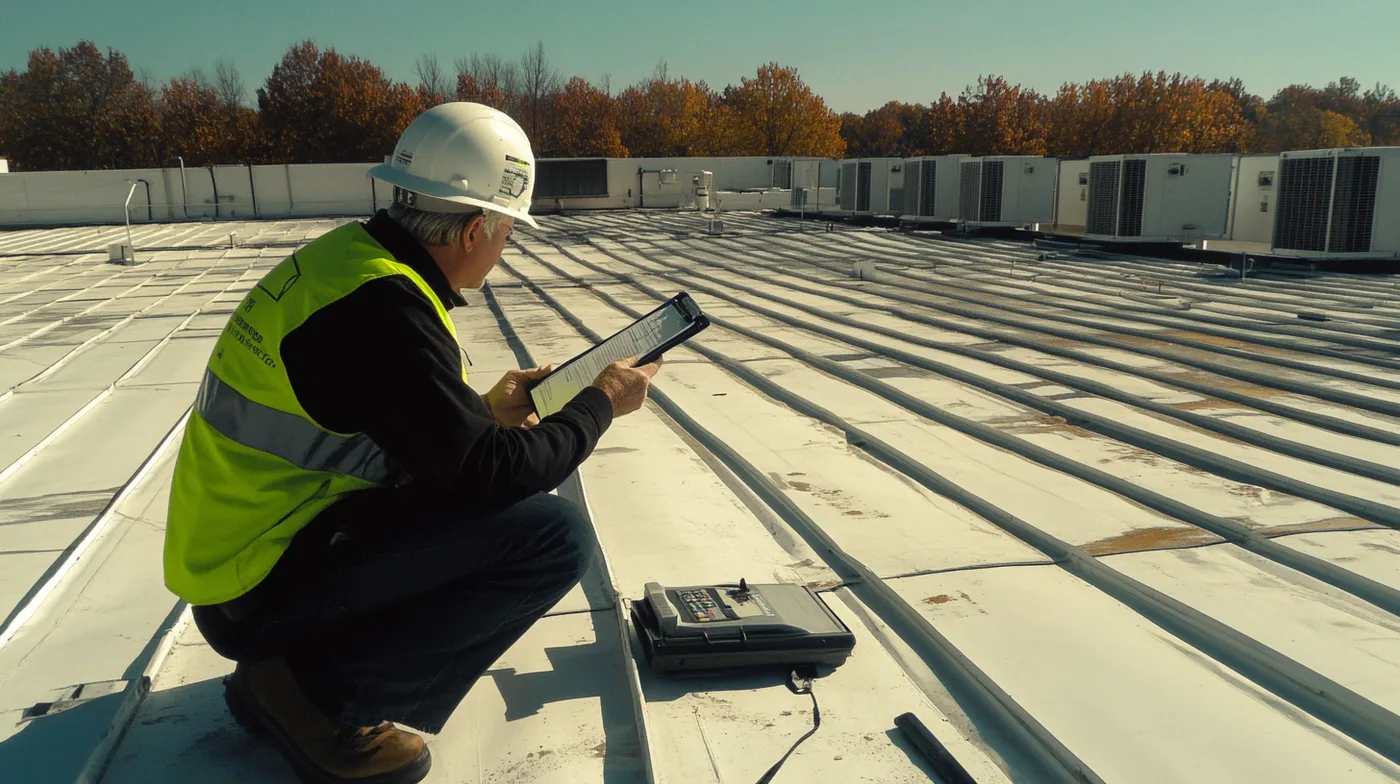
A professional commercial roof inspection is not a visual walk-around. A qualified inspector examines:
- Membrane integrity — seam adhesion, punctures, blistering, and UV degradation on TPO, EPDM, and PVC systems
- Flashing condition — perimeter edge metal, HVAC curb flashings, pipe penetrations, and parapet caps (the most common storm failure points)
- Drainage systems — interior drains, scuppers, gutters, and downspouts; ponding areas indicating drain blockage or inadequate slope
- Fastener and attachment assessment — mechanical fasteners backing out, adhesive failure at seams, or wind uplift evidence
- Insulation condition — moisture in insulation layers detected by core sampling or infrared thermography
- Roof deck condition — visible from inside; water staining, deflection, or rot in wood decks
Standard flat roof inspections cost $0.05–$0.10 per square foot. A professional inspection for a 10,000 sq ft flat roof runs $500–$1,000 — done twice per year, that's $1,000–$2,000 annually for a property that might cost $150,000+ to re-roof.
Building your maintenance program: a 12-month calendar
Pre-Season Inspection (April–May)
Full professional inspection before hurricane season. Identify and repair any membrane damage, loose flashings, blocked drains, or lifting seams. Document baseline condition with dated photos. This is your most important inspection — it establishes pre-storm condition for insurance purposes.
Post-Storm Checks (After each significant event)
Self-assessment after any storm with sustained winds above 50 mph or significant hail. Check for obvious membrane damage, displaced flashings, debris on roof, and blocked drains. Call for professional inspection if anything is found or if the storm was severe.
Post-Season Inspection (October–November)
Second full professional inspection after hurricane season ends. Identifies any storm damage accumulated during the season. Documents condition for year-end insurance policy renewal discussions.
Drainage Maintenance (Quarterly)
Clear all roof drains, scuppers, gutters, and downspouts quarterly. Debris accumulation during dry months causes drainage failures during the first major storm. This task can be performed by building maintenance staff — it doesn't require a licensed roofer.
Maintenance records your insurer needs to see
After a storm claim, your insurer's adjuster will ask for your maintenance history. What protects you:
- Dated inspection reports from licensed commercial roofing contractors — not internal staff walkthroughs
- Repair invoices with work descriptions, dates, and contractor information
- Pre-storm photo documentation timestamped and showing roof condition before the claim event
- Drain cleaning logs showing routine maintenance was performed
⚠️ The deferred maintenance denial argument
The most common commercial storm claim denial reason is "pre-existing condition" or "deferred maintenance." Insurers argue the damage wasn't caused by the storm — it was caused by neglect, and the storm just revealed it. A documented maintenance program with professional inspection reports directly refutes this argument. Without records, you're defending against that argument with nothing.
Informational purposes only. The content on this page is general educational information about commercial roofing and property insurance — it is not legal advice, insurance advice, or a guarantee of any specific outcome. Insurance policies, lease terms, building codes, and contractor licensing requirements vary by state, carrier, and individual circumstances. Always consult a licensed insurance professional, attorney, or qualified contractor for advice specific to your situation. StormRoofQuotes is a roofing lead-generation service and is not a licensed insurer, attorney, or financial advisor.