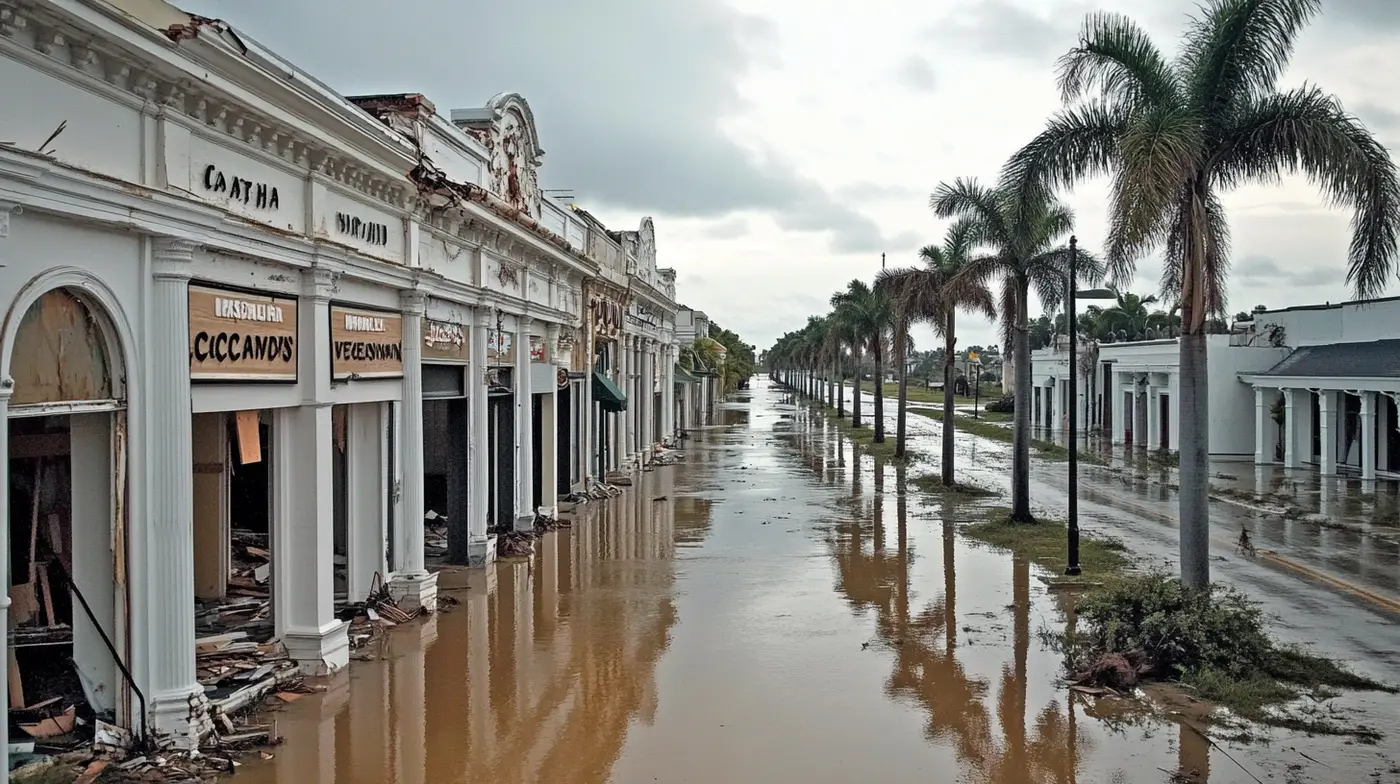
Commercial property insurance excludes flood — completely
This is not a gray area, a nuanced exclusion, or a technicality. Standard commercial property insurance policies contain an explicit flood exclusion covering all flooding regardless of cause — rising water, storm surge, overflow from water bodies, drainage backup, and any other form of surface water accumulation. The exclusion is typically found in the policy's Exclusions section and uses language such as "we will not pay for loss or damage caused directly or indirectly by flood, surface water, waves, tidal water, overflow of a body of water, or spray from any of these."
When Hurricane Ian drove storm surge into coastal Florida commercial properties in 2022, the wind damage was covered by commercial property policies. The flood damage — which in many cases was the majority of the loss — was not. Business owners who had not purchased separate flood coverage had no recourse for the flood-driven damage regardless of their commercial property policy limits or premium history.
The most expensive hurricane peril for coastal commercial properties is specifically excluded from commercial property insurance
Storm surge — the wall of ocean water pushed inland by hurricane winds — is classified as a flood peril, not a wind peril. Damage caused by storm surge is covered only by flood insurance, not by commercial property insurance. In major coastal hurricanes, storm surge is frequently the dominant loss mechanism — it was responsible for approximately 50% of Hurricane Katrina's insured losses and a significant portion of Ian's coastal commercial losses. Every coastal commercial property owner who does not carry separate flood insurance has zero coverage for this specific, major, and entirely foreseeable peril.
NFIP commercial coverage — what it provides and where it falls short
The National Flood Insurance Program's General Property Form is the federal flood insurance product for commercial properties. It is the primary commercial flood coverage option for most small to mid-size coastal businesses and the baseline understanding every coastal commercial property owner needs.
NFIP commercial policy basics
- Building coverage maximum: $500,000 per building — the statutory cap regardless of property value
- Contents coverage maximum: $500,000 per policy — inventory, equipment, furnishings, business personal property
- Coverage basis: Actual Cash Value (ACV) — not replacement cost. Depreciation is applied to both building and contents. This means a building worth $500,000 to replace may receive significantly less than $500,000 if the structure has depreciated.
- Waiting period: 30 days before coverage takes effect — you cannot buy NFIP coverage when a storm is approaching
- Business interruption: NOT included — the NFIP General Property Form does not cover lost income or extra expenses during a flood-forced closure
- Underground structures and outdoor property: Limited or excluded — parking lots, fences, landscaping, and most outdoor property are not covered
The coverage gap in real numbers
This gap — over $1.4 million of uninsured flood exposure on a building the owner believes is "flood insured" — is not unusual. It is the typical situation for most mid-size coastal commercial properties carrying only NFIP coverage. The NFIP's $500,000 building cap has not been updated for construction cost inflation since the program's expansion in the 1970s, and most coastal commercial buildings built or renovated in the last 20 years have replacement costs well above this cap.
Private commercial flood insurance — higher limits, broader coverage
The private commercial flood market has expanded significantly since 2017, providing options that address the NFIP's most significant limitations: coverage limits, ACV vs. replacement cost settlement, business interruption exclusion, and the range of covered perils.
The federal baseline
- Federally guaranteed — cannot be non-renewed for risk reasons
- Standardized nationwide — same policy form everywhere
- Required by most lenders in SFHA zones
- Available in all participating communities
- Building cap: $500,000 (ACV basis)
- Contents cap: $500,000 (ACV basis)
- No business interruption coverage
- 30-day waiting period
- ACV settlement — depreciation reduces payout
- Limited outdoor and underground coverage
Addresses NFIP gaps
- Building limits well above $500K — up to $10M+ from major carriers
- Replacement cost settlement available (no depreciation)
- Business interruption from flood available
- Shorter or no waiting periods on some policies
- Broader coverage of outdoor property and equipment
- Some policies include mold remediation coverage
- Not federally guaranteed — carriers can non-renew
- Coverage terms vary significantly by carrier
- Some coastal markets experiencing market withdrawal
- Requires careful policy review — not standardized
The layered approach — what most sophisticated coastal property owners carry
The optimal commercial flood coverage structure for most coastal properties uses multiple layers:
NFIP General Property Form — $500K building / $500K contents
The federal base layer. Provides guaranteed renewable coverage that private carriers cannot match for long-term stability. Required by most commercial lenders in Special Flood Hazard Areas. Establishes the foundation with the federal program's backing while accepting its ACV limitation and $500K cap.
Private excess flood — covering the gap above $500K to full RCV
Excess flood coverage sits above the NFIP and pays after NFIP limits are exhausted. For a building with $1.8 million replacement cost, the excess policy covers from $500,000 to $1,800,000. Available from commercial specialty carriers including Swiss Re, Lloyd's syndicates, Zurich, and Neptune's commercial division. Premiums reflect the specific property's flood risk — elevation, distance from water, and historical flood experience all factor in.
Commercial flood business interruption endorsement
A separate BI endorsement on the private flood policy that covers lost income and extra expenses when flood damage forces a closure. The NFIP General Property Form does not include BI — this must come from a private carrier. Not all private flood policies include BI; it must be specifically requested and confirmed. For businesses where a flood closure would trigger significant revenue loss — restaurants, hotels, retail, hospitality — this layer is essential.
NFIP's guaranteed renewal is a real advantage for coastal properties on long-term financing
Private flood carriers can and do non-renew commercial policies in coastal markets after major storm seasons. After Hurricane Ian in 2022 and active 2024–2025 seasons, several private carriers reduced their Florida coastal commercial books. A commercial property with a 20-year mortgage that loses its private flood coverage mid-term faces a financing problem — lenders require continuous flood coverage in SFHA zones. NFIP policies cannot be non-renewed for underwriting reasons (only for failure to pay premium or program non-participation). For long-term coastal ownership, maintaining an NFIP policy as the base layer — even if private excess covers the gap — provides renewal security that private carriers alone cannot guarantee.
Storm surge — confirming your flood policy actually covers it
Storm surge is ocean water pushed inland by hurricane winds. It is classified as a flood peril. It is excluded from commercial property insurance. For coastal commercial properties in the Gulf of Mexico and Atlantic coastal zones, storm surge is frequently the largest single peril exposure — larger than wind damage, larger than rainfall flooding, and capable of destroying everything at ground level regardless of roof condition.
Verifying storm surge coverage in your NFIP policy
NFIP policies cover storm surge as a form of flooding under their definition: "a general and temporary condition of partial or complete inundation of two or more acres of normally dry land area or of two or more properties from overflow of inland or tidal waters." Storm surge from a hurricane qualifies under this definition. NFIP storm surge coverage is standard — it does not need to be specifically confirmed in policy language.
Verifying storm surge coverage in private flood policies
This requires careful policy review. Private flood policies are not standardized and some have specific provisions that can limit storm surge coverage. Review your private flood policy specifically for:
- Storm surge sub-limits — some policies cap storm surge coverage at a lower amount than the overall building limit
- Named storm exclusions or deductibles — some private policies impose higher deductibles or sub-limits specifically for named tropical storms or hurricanes
- Tidal water exclusions — policies that exclude "tidal water" may partially limit storm surge coverage depending on how the surge originated
- Geographic restrictions — some private policies have coastal proximity restrictions that affect storm surge coverage availability for properties within specific distances of the shoreline
Ask your private flood carrier or agent specifically: "Does this policy cover storm surge damage from a named hurricane at my specific address, and is there any sub-limit or special deductible that applies?" Get the confirmation in writing and attach it to your policy file.
After a major hurricane, insurers dispute which damage was wind and which was flood
When a commercial building suffers damage from both hurricane winds and subsequent storm surge, the post-loss dispute over what caused each element of damage is predictable and expensive. Wind is covered by commercial property insurance; flood by the flood policy. Damage that preceded the flood surge — broken windows, breached doors, structural movement from wind — is a property claim. Damage caused by water inundation is a flood claim. The forensic engineering analysis required to separate these causes is standard in major coastal hurricane claims and can extend the claims process significantly. Pre-storm documentation — dated photos, video, and a professional inspection report — is your best tool for supporting the cause-of-loss analysis after the event.
FEMA flood zones — what they mean for your commercial property
FEMA flood zone designations govern mandatory flood insurance purchase requirements, premium rates, and development restrictions. Every commercial property owner should know their property's flood zone designation and understand what it means for coverage requirements and risk.
| Zone | Risk Level | Description | Mandatory Flood Insurance? |
|---|---|---|---|
| Zone A | High risk | Special Flood Hazard Area — 1% annual chance of flooding (100-year flood). No base flood elevation determined. | Yes — required for federally backed mortgages |
| Zone AE | High risk | SFHA with base flood elevation determined. Most common coastal commercial designation. | Yes — required for federally backed mortgages |
| Zone VE | Highest risk | Coastal high hazard area — subject to high velocity wave action in addition to flooding. Highest premiums. | Yes — required; highest risk zone |
| Zone AO | High risk | Shallow flooding areas with average depths of 1–3 feet. River and stream overflow and urban drainage areas. | Yes — required for federally backed mortgages |
| Zone X (shaded) | Moderate risk | 0.2% annual chance of flooding (500-year flood). Between 1% flood boundary and 0.2% boundary. | Not required, but strongly recommended |
| Zone X (unshaded) | Low-to-moderate risk | Area of minimal flood hazard outside SFHA. Flood risk still exists — 26% of NFIP claims come from Zone X properties. | Not required |
Look up your property's flood zone at msc.fema.gov
FEMA's Flood Map Service Center at msc.fema.gov allows any property owner to look up the current flood zone designation for any address. Enter your property address, retrieve the current Flood Insurance Rate Map (FIRM), and note your zone designation. Keep this on file — flood map amendments and Letters of Map Revision (LOMRs) can change your zone designation, affecting both your mandatory purchase obligation and your premium. If your property has been elevated or modified since the current map was created, a Letter of Map Amendment (LOMA) may remove it from the mandatory purchase zone and reduce your premium.
The Zone X problem — flood doesn't respect map boundaries
A significant percentage of NFIP flood claims — approximately 26% historically — come from properties outside the Special Flood Hazard Area. Zone X properties have no mandatory purchase requirement, and many commercial property owners in these zones carry no flood coverage at all. In major hurricane events, storm surge and rainfall-driven flooding frequently extend well beyond SFHA boundaries. Businesses in Zone X that were not required to purchase flood insurance have no coverage when the water arrives.
If your commercial property is in Zone X but within 5 miles of the coast or a major river system, the absence of a mandatory purchase obligation does not mean the absence of risk. A moderate flood event or above-average storm surge can easily reach Zone X properties. The decision to carry flood insurance should be based on actual risk exposure, not just regulatory obligation.
The 30-day waiting period — why flood coverage must be purchased now
NFIP policies have a mandatory 30-day waiting period from application before coverage takes effect. This is statutory — it cannot be waived, shortened, or accelerated for any reason related to an approaching storm. If a named storm is in the Gulf or Atlantic when you call to purchase flood insurance, you have missed the window for that storm entirely.
This rule was implemented specifically to prevent people from buying flood coverage only when a storm is imminent and canceling afterward. The consequence is straightforward: flood coverage must be in place year-round, purchased during the non-storm season, and maintained continuously. A commercial property owner who realizes they have no flood coverage when watching a hurricane approach the coast has no option to address that gap in time.
Private flood waiting periods
Some private flood carriers offer shorter waiting periods — as little as 1–15 days — compared to the NFIP's 30-day requirement. However, private carriers typically also restrict new policy binding when named storms are active or when a property is in the storm's projected path. The practical window for purchasing new private flood coverage is equally limited during active storm periods. The solution is identical: purchase flood coverage before hurricane season and maintain it continuously.
The only time to buy flood coverage is before June 1
Atlantic hurricane season runs June 1 through November 30. The NFIP's 30-day waiting period means any policy purchased after approximately May 1 may not be in effect for early-season storms. For continuous protection through the full season, purchase or renewal confirmation should happen in April or early May at the latest. If you are reading this during an active storm season and do not have flood coverage, mark your calendar and purchase it the day after the final storm of the season — do not wait until next spring.
What to verify every May before hurricane season
NFIP Policy Verification
- Policy in force and premium current — confirm renewal date is not during hurricane season
- Building coverage at the $500,000 maximum (or confirm why lower limit is carried)
- Contents coverage confirmed at appropriate limit for current inventory and equipment value
- Deductible amount confirmed and budgeted
- Property flood zone designation verified against current FEMA map
- Any pending map amendments or LOMRs that could change zone designation
Excess Flood / Private Flood Verification
- Excess flood policy in force with building limit covering the gap above $500K to full replacement cost
- Storm surge confirmed as a covered peril with no sub-limit — written confirmation from carrier
- Named storm deductibles identified and budgeted
- Business interruption from flood confirmed if carried — indemnity period and coverage basis verified
- Carrier stability assessed — any market withdrawal notices received?
- Contents and equipment limits updated for current values (major equipment purchases since last renewal?)
Documentation for Flood Claims
- Pre-storm photos of all ground-floor contents, equipment, and building interior — dated
- Inventory of business personal property with current values — ideally a formal appraisal
- Equipment serial numbers and purchase documentation on file
- Current building replacement cost appraisal — supports both flood and commercial property claims
- Prior survey or elevation certificate on file (affects NFIP premium and coverage basis)
- Financial records accessible from off-site for business interruption claim (cloud backup)