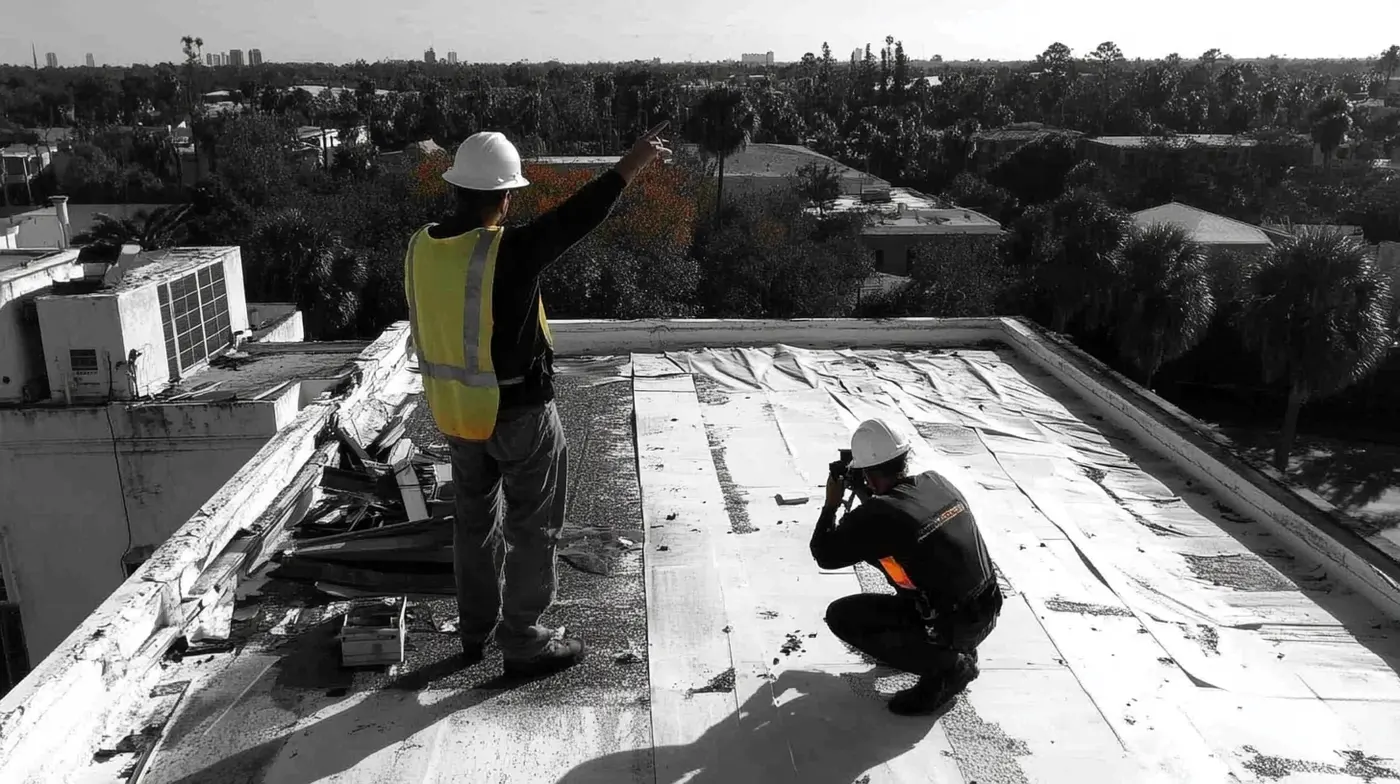
Why flashing fails before the membrane does
A commercial roof membrane — TPO, EPDM, or built-up roofing — is designed to withstand significant wind and water exposure. But every roof membrane has edges, penetrations, and transitions where it meets vertical surfaces, equipment, or building elements. These transition points are protected by flashing. And flashing, by its nature, is the most mechanically stressed part of any roofing system.
Wind pressure doesn't push evenly on a flat roof surface — it concentrates at edges, corners, and protrusions. During a hurricane or severe thunderstorm, the highest uplift forces occur at perimeter edges and around rooftop equipment. This is precisely where flashing lives. A 2025 commercial roofing report from Engineered Roofing Systems confirmed that flashing failures represent the most common storm entry points on commercial roofs.
The six flashing failure points after a storm
Perimeter edge metal
Metal edge trim (coping) along the parapet walls and roof perimeter is the first thing wind lifts in a hurricane. Once edge metal displaces, the membrane beneath it is exposed to direct uplift forces. Check for lifted, displaced, or separated edge metal after any storm with sustained winds above 60 mph.
HVAC curb flashings
Every rooftop HVAC unit sits on a raised curb with flashing sealing the curb-to-membrane transition. These flashings are stressed by the constant vibration of HVAC operation AND wind loading during storms. Post-storm HVAC curb flashing inspection should be standard practice on any commercial building.
Pipe penetration boots
Plumbing vents, gas lines, and other pipe penetrations through the roof are sealed with rubber or metal boot flashings. These fail from UV degradation, thermal cycling, and wind stress. A cracked or separated pipe boot allows water infiltration directly into the building — often appearing as a ceiling stain well away from the actual breach point due to lateral water travel.
Parapet wall caps and copings
Parapet walls (the raised walls at roof edges) are capped with metal coping or masonry. Storm winds drive water horizontally across these surfaces and under any gap in the coping. Loose or displaced coping allows water to penetrate the parapet wall cavity and migrate into the building interior.
Skylight and roof hatch perimeters
The flashing perimeter around skylights, roof hatches, and smoke vents concentrates water runoff and experiences significant thermal movement. Post-storm inspection should include checking for lifted flashing edges, separated sealant beads, and displaced cover plates.
Expansion joint covers
Large commercial buildings have expansion joints that accommodate thermal movement. The covers over these joints are particularly vulnerable to wind uplift and can displace entirely during a major storm, leaving a gap that allows water to drain directly into the building structure.
Documenting flashing damage for your insurance claim
Flashing damage is frequently undervalued or missed entirely by insurance adjusters who focus on membrane surface damage. To protect your claim:
- Photograph every flashing location — before and after the storm. Pre-storm photos showing intact flashings make the storm-caused displacement undeniable.
- Document the failure mode — lifted, separated, cracked, displaced, or corroded. Each failure mode has a different cause and different repair cost. Your contractor's inspection report should specify failure mode for each flashing location.
- Note water intrusion paths — water entering through a displaced HVAC curb flashing may travel 20–30 feet before appearing as an interior ceiling stain. Document the entry point separately from the interior damage location.
- Include all metal components — damaged HVAC unit housings, bent satellite dish mounts, dented metal coping, and cracked skylight frames are all potentially claimable storm damage, not just the roofing membrane.
📋 The lateral travel effect
Water entering a commercial roof through a flashing failure doesn't fall straight down. It travels laterally through the insulation layer and may emerge as an interior stain 10–30 feet from the actual breach point. Adjusters sometimes use this to argue the visible damage point isn't storm-related. Your inspector should identify and document both the entry point (the flashing failure) and the interior damage separately.
Informational purposes only. The content on this page is general educational information about commercial roofing and property insurance — it is not legal advice, insurance advice, or a guarantee of any specific outcome. Insurance policies, lease terms, building codes, and contractor licensing requirements vary by state, carrier, and individual circumstances. Always consult a licensed insurance professional, attorney, or qualified contractor for advice specific to your situation. StormRoofQuotes is a roofing lead-generation service and is not a licensed insurer, attorney, or financial advisor.